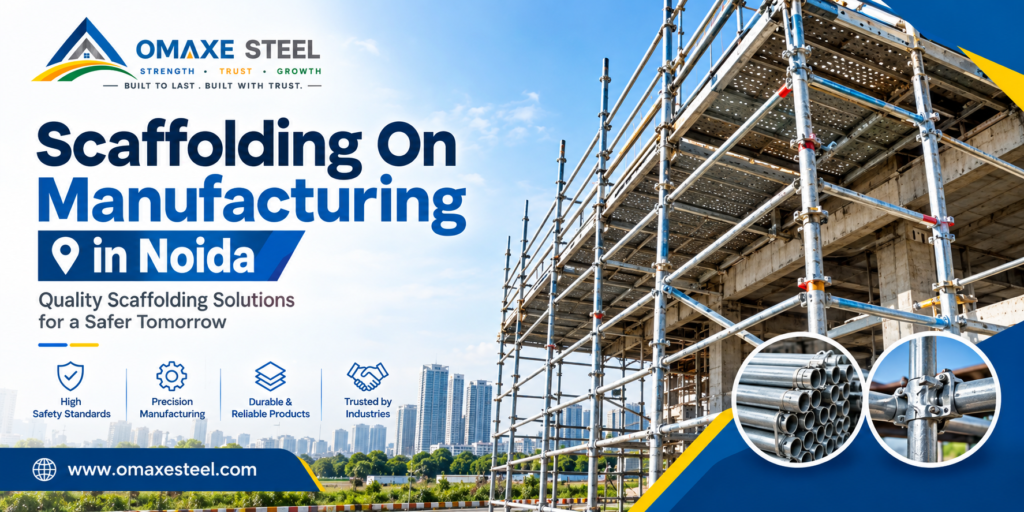
Scaffolding manufacturing is the process of turning raw steel into pipes, fittings and support components that form temporary working platforms on construction sites. Choosing a reliable manufacturer matters because scaffolding carries people, tools and materials at height. Small errors in dimensions, welding or finish can turn into safety and fitting problems on site.
Noida and the wider Delhi NCR region see steady residential, commercial, industrial and infrastructure work. That keeps demand for dependable scaffolding materials high. Contractors and project managers here usually want the same things: components that fit together, arrive on time and hold up across repeated use.
This guide explains how Scaffolding On Manufacturing in Noida typically works, which types and materials are common, and how to judge quality before you buy. It also introduces Omaxe Steel Equipments, a steel and industrial products company that, according to its website, has operated since 2013 and offers scaffolding materials and related steel products for construction and infrastructure needs.
What Is Scaffolding Manufacturing?
Scaffolding manufacturing is the production of steel pipes, couplers, base plates, props and other components that are assembled on site to create a safe, temporary structure for construction work.
Scaffolding is a temporary framework that lets workers reach heights for building, repairing, plastering, painting or inspecting a structure. It is not a single product. It is a set of parts that must work together as one system.
Why steel is commonly used
Steel is the usual choice for construction scaffolding because it is strong, rigid and can be reused across many projects. Compared with timber or bamboo, steel components can be made to consistent sizes, which makes assembly more predictable. Mild steel in particular is widely used because it is easy to cut, weld and fabricate.
How the components work together
A typical steel scaffold uses vertical members, horizontal members, diagonal braces, base plates at the bottom and clamps or fittings at the joints. Each part has a defined role. Base plates spread the load to the ground. Pipes form the frame. Clamps and ledger blades lock the frame together.
Why accuracy and consistency matter
If pipes vary in length or fittings do not match the pipe diameter, the structure may not sit square or tighten properly. Consistency across a batch is just as important as the quality of any single piece. A site crew should be able to pick up any component from the stack and expect it to fit.
Scaffolding Manufacturing Process in Noida
The exact workflow varies from one factory to another, and it depends on the product being made. The stages below describe how steel scaffolding is generally manufactured in India. They are industry-level steps, not a description of any specific company’s machinery.
1. Raw material selection. Everything starts with the steel. Manufacturers choose pipes, sheets or bars suited to the component being made. Checking material consistency at this stage prevents problems later, since poor input cannot be fixed by good finishing.
2. Cutting and sizing. Steel pipes and sections are cut to the required lengths. Accurate cutting matters because even small differences add up when many components are joined in one scaffold.
3. Forming and fabrication. Parts are shaped according to their function. Plates may be cut and formed into base plates. Sections may be shaped into ledger blades or prop components. Pipes may be prepared for fittings.
4. Welding. Where components need permanent joints, such as a plate welded to a pipe, welding is carried out. Clean, even welds without visible gaps or cracks are a basic sign of careful work.
5. Threading and component preparation. Items like prop jacks need threaded sections so height can be adjusted. Threads must be clean and cut properly so they turn smoothly under load.
6. Surface finishing. Components are cleaned and finished to protect them from rust and wear. Depending on the product, this may involve painting, coating or other treatment.
7. Dimensional inspection. Lengths, diameters and alignment are checked against the intended size. This is where consistency across a batch is confirmed.
8. Quality checking. Welds, threads, fittings and finish are inspected. Defective pieces should be corrected or rejected before they leave the unit.
9. Final preparation and dispatch. Finished components are sorted, bundled and prepared for delivery. Good handling at this stage prevents bending, scratching and mixed-up consignments.
For buyers, the useful takeaway is simple. Quality in scaffolding manufacturing in Noida, or anywhere else, is built in at every stage rather than added at the end.
Types of Scaffolding Used in Construction
It helps to separate scaffolding systems, which are complete assemblies, from scaffolding components, which are the individual parts used to build or support them.
Common scaffolding systems
Tube-and-clamp scaffolding uses steel pipes joined by clamps. It is flexible and can be adapted to irregular building shapes, which is why it is common on Indian sites.
Cuplock scaffolding uses vertical standards with fixed cups and horizontal ledgers that lock into them. The connection points are built in, so assembly is typically quicker and more uniform.
H-frame scaffolding uses prefabricated frames connected by braces. It suits straightforward, repetitive work such as plastering or painting along a wall.
Adjustable steel props are not a full scaffold. They support formwork and slabs during construction, and their height can be adjusted to suit the floor level.
| Type | General characteristics | Typical applications |
| Tube-and-clamp | Flexible, assembled from pipes and clamps, suits irregular layouts | Buildings with varied shapes, repair work, façade access |
| Cuplock | System-based, built-in connection points, uniform assembly | Large residential and commercial projects, repetitive structures |
| H-frame | Prefabricated frames with braces, simple to erect | Plastering, painting, finishing along straight walls |
| Adjustable steel props | Height-adjustable vertical supports | Slab and formwork support during construction |
Individual scaffolding components
Components are the parts that make these systems work. They include:
- Scaffolding pipes: the main structural members of tube-based systems
- Clamps and fittings: used to join pipes at right angles or other positions
- Base plates: placed under vertical members to spread load and improve stability
- Ledger blades: horizontal connecting pieces used in system scaffolding
- Prop jacks: threaded accessories used to adjust height
According to its website, Omaxe Steel Equipments lists scaffolding parts such as cast iron scaffolding pipe clamps, mild steel ledger blades, mild steel scaffolding base plates, mild steel scaffolding prop jacks and mild steel silver scaffolding clamps. It also lists mild steel scaffolding pipes.
Materials Used in Scaffolding Manufacturing
Material choice affects strength, durability, stability and how long a component stays usable. This section covers general industry practice. Specific grades and technical values should always be confirmed with the supplier.
Mild steel
Mild steel is widely used for scaffolding pipes and many fabricated parts. It is workable, readily available and suitable for welding and shaping. These qualities make it practical for components that are produced in volume and used repeatedly.
Steel pipes
Pipes are the backbone of most scaffolds. Their usefulness depends on consistent diameter, straightness and uniform quality along the length. A pipe that is bent or uneven can affect how fittings grip and how the frame sits.
Fittings and connection components
Clamps, base plates and similar parts take concentrated stress at joints. They need to match the pipes they connect to. Cast iron is used for some clamps, while mild steel is used for many other parts. Whatever the material, fit and finish matter as much as the metal itself.
Surface protection
Scaffolding stays outdoors, often in dusty, humid or wet conditions. Surface finishing helps slow corrosion and keeps components in better shape between uses. Rust is more than a cosmetic problem. Heavy corrosion can weaken a component over time.
How to Check Scaffolding Quality Before Buying
Quality checks do not need laboratory equipment. A careful visual and practical inspection can reveal a lot. Here is what to look at.
Material consistency. Components from the same batch should look and feel uniform. Large differences in thickness, colour or finish can signal inconsistent sourcing.
Pipe dimensions. Check that diameter and length match what you ordered. Measure a sample if the order is large.
Straightness. Roll a pipe on a flat surface or sight along its length. Visible bends make assembly difficult and can affect stability.
Weld quality. Look for even, continuous welds. Cracks, gaps, holes or heavy spatter are warning signs.
Connection and fitting accuracy. Test whether clamps, base plates and prop jacks fit properly with the pipes you plan to use. Threads should turn smoothly.
Surface condition and corrosion protection. The finish should be even, without flaking or heavy rust.
Overall finish. Sharp burrs, rough edges and careless cutting suggest limited quality control.
Supplier reliability. Ask about their experience, how they inspect products and how they handle supply and support.
Documentation and standards. Where your project requires it, ask what documentation is available and which applicable standards the products follow. Request this in writing rather than relying on verbal assurances.
| Checkpoint | What to look for | Why it matters |
| Material | Uniform appearance and consistent source | Predictable strength and service life |
| Dimensions | Correct and consistent diameter and length | Proper fit and alignment |
| Straightness | No visible bends | Stable, square assembly |
| Welding | Clean, even welds without cracks | Joint reliability |
| Components | Clamps, plates and jacks that match pipes | Compatibility on site |
| Surface condition | Even finish, minimal rust | Longer usable life |
| Quality inspection | Clear inspection process | Fewer defects reaching site |
| Supplier reliability | Experience, support, delivery record | Steady supply and fewer disputes |
Why very cheap scaffolding can cost more
A low price can hide poor dimensions, weak welds or mismatched fittings. Problems then show up on site as delays, rework, replacement purchases and, in the worst case, safety risks. Scaffolding safety depends on every part performing as expected, so the lowest quote is rarely the best value.
Applications of Scaffolding in Noida and Delhi NCR
Scaffolding is used wherever people need safe access to height or temporary structural support.
- Residential construction: apartment towers, independent houses and housing societies need access for structure, plastering and finishing.
- Commercial buildings: offices, showrooms and retail spaces use scaffolding during construction and fit-out.
- Industrial projects: factories and plants need access for structural work, maintenance and installation.
- Warehouses: high roofs and large spans call for temporary access during construction and repair.
- Infrastructure projects: roads, flyovers, bridges and public works use scaffolding and props for temporary support.
- Repair and maintenance: older buildings need safe access for structural repair and waterproofing.
- Plastering and finishing work: workers need stable platforms along walls and ceilings.
- Painting and façade work: exterior painting and cladding depend on scaffolds that can be set up around the building.
Why Choose a Reliable Scaffolding Manufacturer in Noida?
Scaffolding manufacturing in Noida serves a market where project timelines are tight and site conditions vary. A dependable manufacturer helps you avoid surprises. These are the factors worth weighing:
- Consistent manufacturing quality: the hundredth piece should match the first.
- Product availability: you should be able to source what you need when you need it.
- Correct specifications: products should match what was agreed.
- Component compatibility: pipes, clamps and fittings should work together without improvisation.
- Quality inspection: there should be a clear process for checking products before dispatch.
- Reliable supply: repeat orders should look like the first one.
- Customer support: someone should answer questions before and after the sale.
- Delivery capability: materials should reach the site on schedule.
- Experience with construction requirements: a supplier who understands site needs can guide you better.
Omaxe Steel Equipments is one company buyers can consider on these criteria. Its website describes it as a manufacturer, supplier, trader and service provider established in 2013, with a market covering India. It highlights quality-assured products, modern manufacturing and customer support.
Omaxe Steel Equipments for Scaffolding Requirements
Omaxe Steel Equipments deals in scaffolding materials and related steel and industrial products for construction and infrastructure requirements. Its website lists:
- Mild steel scaffolding pipes
- Cast iron scaffolding pipe clamps
- Mild steel ledger blades
- Mild steel scaffolding base plates
- Mild steel scaffolding prop jacks
- Mild steel silver scaffolding clamps
If you are comparing options, you can review these listings on the Scaffolding Parts and Mild Steel Scaffolding Pipes pages, and learn more about the company on the About Us and Services pages. For specifications, quantities or availability, it is best to speak to the team directly and confirm details against your project requirements.
[Editor’s note: replace each placeholder link with the exact page URL after checking that it exists on the live site.]
Frequently Asked Questions
What is scaffolding manufacturing?
Scaffolding manufacturing is the process of making steel pipes, clamps, base plates, props and other components used to build temporary working platforms on construction sites. It includes material selection, cutting, fabrication, welding, finishing, inspection and dispatch. The aim is to produce parts that fit together accurately and stay reliable through repeated use.
Which materials are commonly used for scaffolding?
Steel is the most common material for construction scaffolding, with mild steel widely used for pipes and many fabricated parts. Some fittings, such as certain clamps, are made of cast iron. Surface finishing is often applied to slow corrosion. Exact grades and specifications vary by manufacturer, so confirm them before ordering.
What types of scaffolding are used in construction?
Common systems include tube-and-clamp, cuplock and H-frame scaffolding. Adjustable steel props are also widely used to support slabs and formwork. Each system relies on components such as pipes, clamps, base plates, ledger blades and prop jacks. The right choice depends on the structure, height, access needs and project timeline.
How do I choose a scaffolding manufacturer in Noida?
Look for consistent product quality, correct specifications, compatible components and a clear inspection process. Check availability, delivery ability and customer support. Ask about experience with construction projects and request documentation where your project needs it. Visiting the unit or inspecting samples before a bulk order is also sensible.
What should I check before purchasing scaffolding materials?
Check pipe dimensions, straightness, weld quality, fitting accuracy and surface condition. Make sure clamps, base plates and prop jacks match your pipes. Look for rust and rough finishing. Confirm the supplier’s reliability, delivery timelines and any required documentation. Inspect a sample batch before placing a large order.
Contact Omaxe Steel Equipments
If you need scaffolding materials or related steel products for your project, contact Omaxe Steel Equipments to discuss your requirements. Whether you are comparing options or planning a large order, a clear conversation about specifications and supply is a good place to start. Reliable scaffolding manufacturing in Noida begins with asking the right questions, and the team can help you work through them.
Omaxe Steel Equipments Address: Plot No. 139, Gate No. 1, Metro Pillar 167, Prakash Industrial Estate, Sahibabad, Ghaziabad (UP)
Phone: +91-9891999139
Email: vstamit.139@gmail.com
Website: www.omaxesteel.com
Reach out to discuss your project’s earthing requirements, and the team can guide you toward a suitable pipe specification based on your site conditions and electrical load.