
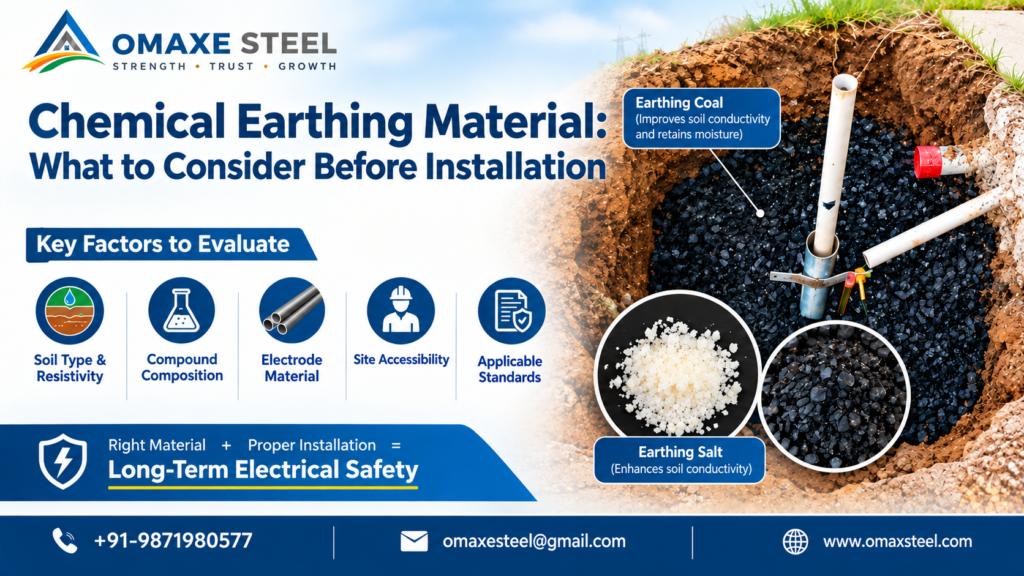
Electrical safety depends on a grounding system that can carry fault current away safely and consistently, and the choice of earthing material plays a direct role in how well that system performs. Among the options available today, chemical earthing material has become a common choice for sites where soil conditions are difficult or where a more stable low-resistance path to ground is needed. However, choosing and installing chemical earthing material is not a one-size-fits-all decision. Soil type, site conditions, electrode selection, and long-term maintenance all influence how well the system performs over time. This article walks through the practical factors that electrical contractors, engineers, and project teams should evaluate before installation, so that the earthing system is planned correctly from the start rather than corrected after problems appear.
Key Factors to Check Before Chemical Earthing Installation
| Factor | Why It Matters | What to Check |
| Soil resistivity | Determines how easily current disperses into the ground | Resistivity test results across seasons |
| Compound composition | Affects compatibility with the electrode and surrounding soil | Manufacturer datasheet and application guidance |
| Electrode material | Impacts durability and current-carrying capacity | Material type, dimensions, and corrosion protection |
| Site accessibility | Affects excavation, pit depth, and future maintenance | Space availability and underground utility mapping |
| Applicable standards | Ensures the installation meets recognised safety practice | Relevant IS codes and project specifications |
What Is Chemical Earthing Material?
Chemical earthing material generally refers to an earth-enhancing compound used around an earthing electrode to improve contact between the electrode and the surrounding soil. It is different from the earthing electrode itself, which is the metallic conductor — typically a pipe, rod, or plate — that is actually driven or placed into the ground. The compound is not a substitute for the electrode; rather, it works alongside it. Its role is to retain moisture and improve the conductive path between the electrode surface and the soil, particularly in locations where the natural soil resistivity is high or where soil conditions vary through the year.
Because chemical earthing material is often used in combination with electrodes such as GI pipes, understanding both components — the electrode and the compound — is necessary before deciding on an overall earthing system design.
How Does a Chemical Earthing System Work?
A chemical earthing system relies on close, continuous contact between the electrode and the earth. When a fault occurs, current needs a low-resistance path to travel from the electrical installation into the ground. The electrode provides the conductive metal path, while the surrounding chemical compound helps maintain soil conductivity around it, especially in dry or rocky conditions where natural soil contact alone may not be sufficient.
The overall effectiveness of this arrangement depends on several variables working together — the electrode’s material and surface area, the compound’s ability to interact with local soil, moisture presence, and the quality of the physical installation. It would be inaccurate to assume that any chemical earthing system automatically delivers a fixed or guaranteed earth resistance value. Actual performance depends on site-specific conditions and should always be confirmed through testing after installation, not assumed in advance.
What to Consider Before Installing Chemical Earthing Material
Before any chemical earthing material is procured or installed, several site and design factors deserve careful evaluation. Skipping this stage is one of the most common reasons earthing systems underperform.
Soil Type and Soil Resistivity
Soil composition varies widely — from sandy and rocky ground to clay-rich or waterlogged areas — and this variation has a direct effect on how a grounding system behaves. Soil resistivity is not a fixed number; it changes with moisture content, temperature, and season. A location that shows acceptable resistivity during the monsoon may behave very differently in peak summer. For this reason, resistivity testing should ideally be carried out at more than one point in time, and the earthing design should account for the worst-case scenario rather than the most favourable reading.
Quality and Composition of Earthing Material
Not every chemical earthing compound on the market has the same composition or performance characteristics. Products differ in how they retain moisture, how they interact with different soil types, and how they are meant to be applied around the electrode. Before selecting a compound, it is worth reviewing the manufacturer’s technical guidance and confirming that the material is appropriate for the specific soil and site conditions involved, rather than assuming that any earthing compound will behave the same way in every installation.
Selection of the Earthing Electrode
The electrode itself needs equal attention. Material choice — such as galvanized iron — along with electrode dimensions and corrosion-resistant treatment, should be matched to the project’s technical requirements and expected service life. Product ranges such as GI earthing pipes and GI earthing strips are commonly used as electrodes or conductors within broader grounding installations, and reviewing the specifications of the chosen electrode against the project’s electrical load and soil conditions is a necessary step before finalising the design. Not every earthing material is designed to function specifically as a chemical earthing electrode, so this distinction should be confirmed during planning.
Site Conditions and Installation Location
The physical location of the earthing pit affects both installation and future access. Contractors should check for underground utilities, cables, or pipelines before excavation, confirm adequate drainage so the pit does not remain waterlogged or completely dry for extended periods, and ensure there is enough clearance for periodic inspection. A poorly chosen location can make maintenance difficult even if the material selection itself was appropriate.
Chemical Earthing Installation Considerations
| Installation Factor | Potential Challenge | Recommended Consideration |
| Pit depth and diameter | Inadequate depth reduces contact with stable moisture layers | Plan depth based on soil profile, not a fixed assumption |
| Backfilling method | Uneven backfilling creates air gaps around the electrode | Follow manufacturer-recommended application method |
| Connection points | Loose or corroded connections increase resistance | Use proper clamps and verify tightness after installation |
| Seasonal soil movement | Ground contraction/expansion can loosen electrode contact | Reassess periodically, particularly after extreme weather |
| Multiple earth pits | Single-pit systems may be insufficient for larger loads | Evaluate whether the project needs an interconnected earthing grid |
Electrical Safety and Applicable Standards
Earthing work should always be carried out in line with recognised electrical safety practices and the specific requirements of the project. In India, IS 3043 is commonly referenced as a general code of practice for earthing, and project specifications may include additional requirements depending on the type of installation. Rather than relying on assumptions, it is advisable to consult the relevant standards and, where necessary, a qualified electrical professional, to confirm what applies to a specific site. This article does not attempt to reproduce specific clauses or mandatory values from any standard, as these should be verified directly from the applicable code and project documentation.
Maintenance and Long-Term Performance
An earthing system is not a one-time installation that can be forgotten afterward. Periodic earth resistance testing helps confirm that the system continues to perform as expected, while visual inspection can catch corrosion, loose connections, or physical damage to the pit cover before they become larger issues. Maintenance schedules are often set based on the type of installation and local conditions, and facility teams should build these checks into their regular electrical safety routines rather than treating earthing as maintenance-free.
Common Mistakes to Avoid During Chemical Earthing Installation
Several recurring mistakes reduce the effectiveness of chemical earthing systems. Ignoring soil resistivity testing and installing electrodes based on assumption rather than data is one of the most frequent issues. Using earthing compounds that are not suited to the soil type, or mixing incompatible materials without checking manufacturer guidance, can also affect performance. Poor physical connections — loose clamps, inadequate backfilling, or exposed joints — create resistance points that undermine the entire system. Incorrect pit depth or diameter, chosen without reference to soil conditions, is another common shortfall. Finally, skipping post-installation earth resistance testing means problems may go unnoticed until a fault actually occurs, at which point the consequences are far more serious than a correction made during planning.
How Omaxe Steel Equipments Relates to Earthing Material Requirements
Omaxe Steel Equipments is associated with the supply of earthing and industrial materials used in electrical grounding projects. The company’s earthing material range includes products such as GI earthing pipes, GI earthing strips, and earthing coal, which are commonly used as part of broader grounding installations across industrial and infrastructure projects. These materials serve different roles within an earthing system — for instance, GI pipes and strips are typically used as electrodes or conductors, while earthing coal is used as backfill material around electrodes to help maintain soil contact and moisture retention in the pit.
It is worth noting that not every product in this category functions specifically as a chemical earthing compound, and project teams should confirm which materials are suited to their particular design before procurement. For readers looking to understand more about how earthing strips are produced and used, Omaxe Steel’s article on earthing strip manufacturing provides additional background on the process, materials, and general benefits involved.
Pre-Installation Checklist for Chemical Earthing
| Checklist Item | Purpose | Status/Verification |
| Soil resistivity test completed | Confirms baseline conditions for design | Test report on file |
| Electrode material and size confirmed | Matches project load and corrosion requirements | Specification sheet reviewed |
| Compound compatibility verified | Avoids adverse reaction with soil or electrode | Manufacturer guidance checked |
| Pit location cleared of utilities | Prevents damage during excavation | Utility mapping completed |
| Applicable standards reviewed | Ensures alignment with recognised safety practice | Reference to IS 3043 and project specs noted |
| Post-installation testing planned | Confirms actual system performance | Testing schedule assigned |
Conclusion
Installing chemical earthing material is not simply about placing a compound around an electrode — it requires a clear understanding of soil conditions, careful material selection, attention to site-specific installation factors, and a commitment to long-term testing and maintenance. Getting these fundamentals right at the planning stage reduces the chances of underperformance later and supports a safer electrical installation overall. Companies such as Omaxe Steel Equipments, which supply earthing materials including GI pipes, GI strips, and earthing coal, are part of the broader ecosystem that contractors and engineers rely on when sourcing components for these projects. Readers planning an earthing installation are encouraged to treat each of the considerations discussed above as a checklist rather than an afterthought.
FAQs
1. What is chemical earthing material used for?
Chemical earthing material, typically an earth-enhancing compound, is used around an earthing electrode to improve contact with the surrounding soil and support better conductivity, particularly in areas with high soil resistivity.
2. What factors should be checked before chemical earthing installation?
Key factors include soil type and resistivity, the composition and compatibility of the earthing compound, the electrode material and dimensions, site accessibility and underground utilities, and compliance with applicable electrical standards.
3. Is soil resistivity important for chemical earthing?
Yes. Soil resistivity directly affects how well current can disperse into the ground, and it changes with moisture and season, which is why testing at different times is recommended before finalising a design.
4. How often should a chemical earthing system be inspected?
Inspection frequency depends on the installation type and site conditions, but periodic earth resistance testing and visual checks for corrosion or loose connections are generally part of a sound maintenance routine.
5. Can chemical earthing material be used with GI earthing pipes?
GI earthing pipes are commonly used as electrodes within grounding systems, and chemical earthing compounds may be used alongside them depending on soil conditions and project design. Compatibility should always be confirmed against the specific products and site requirements involved.
Contact Us
If you are planning an earthing installation and want to explore relevant materials, Omaxe Steel Equipments’ earthing material range — including GI earthing pipes, GI earthing strips, and earthing coal — is available for review on the company website. Visit omaxesteel.com to browse the product range and find more information related to your project requirements.
- Contact Person: Mr. Tarun Barleja
- Address: Plot No. 139, Gate No. 1, Metro Pillar 167, Prakash Industrial Estate, Sahibabad, Ghaziabad (UP)
- Phone: +91-9891999139
- Website: https://omaxesteel.com/