About the Author & Editorial Standards
This article is researched and written by the Omaxe Steel Technical Team, composed of civil engineers, scaffolding system specialists, and construction safety consultants with a combined industry experience of over 25 years across Delhi and the NCR region. Our team has directly worked on scaffolding and shuttering projects for residential towers, metro infrastructure, commercial complexes, and industrial shutdowns.
All technical claims, safety standards, and product specifications in this article are reviewed against the National Building Code (NBC) of India 2026, Bureau of Indian Standards (BIS) guidelines, and IS 3696 (Part I & II) before publication. This article is updated regularly to reflect changes in safety regulation, material availability, and market conditions.
Reviewed by: Senior Civil Engineer, Omaxe Steel | B.Tech (Civil), IIT Delhi | 18 years of field experience across Delhi NCR construction projects.
Summary
Delhi’s construction sector is booming in 2026, and reliable scaffolding is at the heart of every safe, efficient project. Whether you are raising a residential tower, renovating a commercial facade, or executing a large-scale infrastructure contract, finding the right scaffolding on hire in Delhi can make or break your project timeline and budget. This article covers every important aspect of scaffolding hire in Delhi from the types of systems available and the critical role of shuttering material, to safety standards, selection criteria, and why Omaxe Steel stands as the most trusted name in this space. Read on for a complete, expert guide built for builders, contractors, project managers, and site engineers working in the Capital region in 2026.
What is Scaffolding and Why Does It Matter in Delhi?
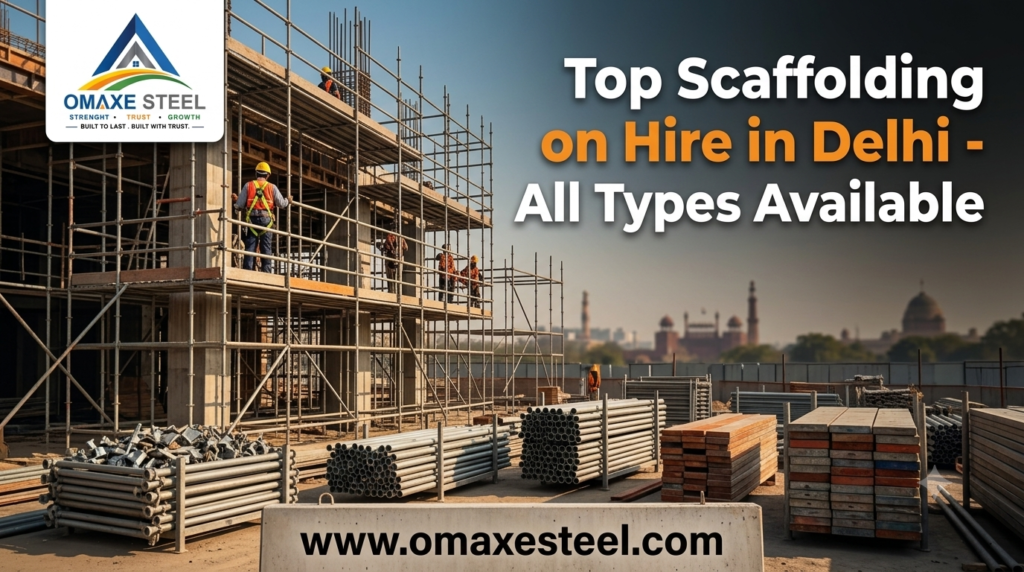
Scaffolding is a temporary load-bearing framework erected around a structure to provide workers with safe, stable access at height. It supports personnel, tools, and construction materials while critical building activities take place on walls, facades, ceilings, and elevated slabs. Without proper scaffolding, construction work at any significant height becomes dangerous, inefficient, and legally non-compliant.
In Delhi specifically, the demand for scaffolding on hire has grown sharply. The National Capital Territory is home to hundreds of concurrent construction projects from smart city developments and metro extensions to private housing societies and commercial complexes. Buying scaffolding outright is rarely cost-effective for most contractors. Hiring it, on the other hand, delivers the right material at the right time without tying up capital unnecessarily.
The Indian scaffolding industry is growing at a CAGR of 6 – 8% in 2026, driven by massive infrastructure programmes, smart city initiatives, and a sector-wide shift from traditional bamboo structures toward safer, more durable steel and aluminium modular systems. Delhi and the wider NCR region sit right at the centre of this transformation.
Omaxe Steel – Your Trusted Partner for Scaffolding on Hire in Delhi
When it comes to scaffolding on hire in Delhi, one name that contractors, builders, and project developers consistently trust is Omaxe Steel. Over more than a decade of active operations across the National Capital Region, Omaxe Steel has supplied scaffolding and shuttering material to residential housing societies, metro contractors, commercial developers, industrial plant operators, and government infrastructure agencies.
That breadth of real-world deployment is not incidental; it reflects a deliberate commitment to quality, safety compliance, and reliable service that has been tested and proven across hundreds of projects in Delhi, Noida, Gurgaon, Faridabad, and Ghaziabad.
What Makes Omaxe Steel Different
Verified Track Record – Omaxe Steel has served projects across every major construction category in Delhi NCR: G+20 residential towers, commercial mall construction, NHAI highway projects, power plant shutdowns, and heritage restoration work. This cross-sector experience means the team understands the precise scaffolding demands of each project type — not just in theory, but from direct field exposure.
BIS and NBC 2026 Compliant Inventory – Every scaffolding system and shuttering component in the Omaxe Steel depot is manufactured and maintained in accordance with Bureau of Indian Standards specifications and the National Building Code 2026 guidelines. Equipment is inspected, cleaned, and load-tested before dispatch. No rusted, bent, or substandard material leaves the yard.
Technical Team with Field Depth – Omaxe Steel’s technical advisors are not salespeople. They are engineers and scaffolding specialists who can read a project layout, assess height and load requirements, and specify the right system with precision. This translates directly into less waste, fewer delays, and zero safety incidents on the client’s site.
Transparent Hire Terms – There are no hidden costs in Omaxe Steel’s hire agreements. Hire period, delivery scope, return conditions, and extension terms are set out clearly in writing before material moves.
Pan-NCR Delivery Network – Material is dispatched promptly to all zones of Delhi and across the wider NCR, with delivery timelines confirmed at the point of booking.
Omaxe Steel provides:
- A comprehensive inventory of all major scaffolding systems
- Well-maintained, inspected, and ready-to-deploy equipment
- Flexible hire periods tailored to project timelines
- Prompt delivery and pickup across Delhi and NCR
- Full support from technical consultation to on-site guidance
- Compliance with BIS and NBC 2026 guidelines across all supplied material
All Types of Scaffolding Available on Hire in Delhi
One of the most important things to understand before hiring scaffolding is that different construction tasks call for different systems. Using the wrong type of scaffold can compromise worker safety, slow down work, and lead to costly rework. Below is a detailed breakdown of all the major scaffolding types available on hire in Delhi in 2026.
1. Cuplock Scaffolding
Cuplock scaffolding is the most widely used modular system in India and across the world and for good reason. It uses a distinctive cup-and-blade locking mechanism, where ledgers slot into cups on vertical standards and are locked with a single hammer strike. This makes assembly extremely fast, requires fewer loose fittings, and delivers exceptional load-bearing capacity.
Cuplock scaffolding is ideal for:
- High-rise residential and commercial construction
- Facade scaffolding
- Staircase towers
- Birdcage structures
- Concrete shoring and formwork support
Its modular nature means it adapts well to curved and irregular structures, which makes it a favourite on complex builds. Omaxe Steel maintains a large, well-maintained cuplock inventory available for hire across Delhi.
2. H-Frame (Frame and Brace) Scaffolding
H-frame scaffolding gets its name from its H-shaped panels that stack vertically and connect using cross-braces and locking pins. This is a fast-erect system that requires minimal training to assemble correctly. It is commonly used for low-to-medium height residential and light commercial projects.
Key advantages of H-frame scaffolding:
- Very quick erection and dismantling
- Standardised components reduce assembly errors
- Ideal for repetitive, regular-shaped building facades
- Cost-effective for smaller projects
3. Ringlock (Rosette) Scaffolding
Ringlock scaffolding uses rosette connectors welded onto vertical standards. Up to four braces and ledgers can be locked into a single rosette with one pin, giving the system exceptional flexibility on complex layouts, curved structures, and sites with tight access points.
Ringlock is widely used on:
- Tunnel and bridge construction
- Industrial maintenance
- Projects with angular or non-standard geometry
- Large-scale infrastructure works
4. Tube and Coupler (Tubular) Scaffolding
Tube and coupler scaffolding is one of the oldest and most adaptable systems. Steel tubes are connected by adjustable couplers right-angle, swivel, or sleeve allowing the system to conform to virtually any structural shape or site constraint.
This system is particularly valuable for:
- Heritage building restoration
- Sites with irregular geometries
- Projects where modular systems cannot be configured efficiently
- Industrial and heavy-load applications
Tube and coupler scaffolding requires skilled assembly and takes longer to erect than modular systems, but it remains the most versatile option available.
5. Suspended Scaffolding
Suspended scaffolding is hung from the roof or upper structure of a building using wires, ropes, chains, or cables. The platform can often be raised and lowered mechanically, making it ideal for high-rise exterior work where ground-supported scaffolding is impractical.
Suspended scaffolding is used for:
- High-rise exterior painting and finishing
- Window washing and facade cleaning
- Building repair and maintenance work above 30 metres
- Glass facade installation on tall commercial buildings
6. Cantilever Scaffolding
Cantilever scaffolding is used when it is not possible to erect scaffold from the ground for example, over a busy road, pavement, or drainage channel. Needle beams are anchored inside the building and extend outward to support the scaffold platform. This type requires careful structural engineering and is always verified by a qualified engineer before use.
7. Mobile (Rolling Tower) Scaffolding
Mobile scaffolding towers are mounted on lockable casters, allowing them to be repositioned easily without dismantling. They are ideal for interior work, maintenance tasks, painting, electrical installations, and any job where the working location changes frequently. The casters are always locked before workers mount the platform.
8. Kwikstage Scaffolding
Kwikstage is similar to cuplock but uses V-shaped fittings instead of cups. Assembly is extremely quick with fewer loose components. It is popular for mid-sized commercial and industrial jobs and valued for how efficiently a crew can erect and dismantle it on a tight schedule.
Real-World Insights from Delhi Construction Sites
The following observations come directly from Omaxe Steel’s field experience across active project sites in Delhi and NCR. They reflect the kind of practical knowledge that separates an experienced hire partner from a basic equipment supplier.
Insight 1 – Always Overestimate Your Prop Count One of the most common mistakes on residential slab projects in Delhi is under-ordering adjustable steel props. When a slab pour is in progress, having even 10 – 15% fewer props than required can force a halt. Experienced site engineers at Omaxe Steel recommend ordering a 15% buffer above your structural engineer’s specified quantity.
Insight 2 – Cuplock vs H-Frame: The Decision Most Contractors Get Wrong Many smaller contractors in Delhi default to H-frame scaffolding for all projects because they are familiar with it. However, for any structure above 12–14 metres, cuplock delivers meaningfully better stability and load capacity. The Omaxe Steel technical team routinely advises clients making this switch and has seen erection times actually reduce not increase when crews are properly trained on cuplock assembly.
Insight 3 – Suspended Scaffolding in Delhi’s Commercial Corridor High-rise commercial glass facade projects along the Aerocity, Cyber City, and Noida Expressway corridors consistently require suspended scaffolding platforms. Ground-based systems are impractical at heights above 30 metres, and cantilever systems add structural risk. Omaxe Steel has executed multiple such deployments, and the lesson is always the same: the motorised hoist system must be inspected by a qualified engineer before first use, not just by the erection crew.
Insight 4 – Heritage Sites Demand Custom Configurations Projects in Old Delhi Chandni Chowk restoration, walled city facade repairs, old haveli renovations cannot use standard modular scaffolding. The structural irregularity, narrow lane access, and load sensitivity of old masonry demand tube-and-coupler systems configured specifically for each structure. Omaxe Steel’s team has direct experience in these environments and approaches each heritage project with an individual site assessment.
Insight 5 – Monsoon Season Scaffold Management Delhi’s monsoon season (July – September) is the most hazardous period for construction scaffolding. Waterlogged ground reduces bearing capacity under base plates, wind loading increases significantly, and corrosion on poorly maintained equipment accelerates. Omaxe Steel clients receive pre-monsoon inspection guidance every year, including advice on additional tie-in points, ground drainage management, and equipment withdrawal thresholds during extreme weather.
| Scaffolding Type | Best Suited For | Load Capacity | Erection Speed |
| Cuplock | High-rise, facades, shoring | Heavy-duty | Fast |
| H-Frame | Low-rise residential, commercial | Medium | Very Fast |
| Ringlock | Curved structures, bridges, tunnels | Heavy-duty | Fast |
| Tube & Coupler | Complex/irregular structures | Heavy-duty | Moderate |
| Suspended | High-rise exteriors above 30m | Light to Medium | Moderate |
| Cantilever | Over obstructions (roads, drains) | Medium | Moderate |
| Mobile Tower | Interior, maintenance, painting | Light to Medium | Very Fast |
| Kwikstage | Commercial and industrial mid-rise | Medium-Heavy | Very Fast |
Scaffolding and Shuttering Material on Hire in Delhi
Beyond scaffolding structures themselves, shuttering material on hire plays an equally critical role on any active construction site. Shuttering (also called formwork) is the temporary mould or casing into which fresh concrete is poured. Once the concrete sets and gains sufficient strength, the shuttering is removed and reused.
In Delhi’s fast-paced construction environment, buying shuttering material outright is rarely economical. Hiring it from a reliable supplier like Omaxe Steel ensures:
- Access to a range of well-maintained shuttering panels and props
- Materials inspected and prepared before dispatch
- Flexible hire durations matching your concrete pour schedule
- Quick turnaround for project handovers
Key Shuttering Materials Available on Hire
Steel Shuttering Plates – Reusable, durable panels for slab, column, and beam formwork. These deliver a smooth concrete finish and can withstand the high pressures of wet concrete pours.
Adjustable Steel Props (Acrows) – Vertical telescopic supports used to hold shuttering and slab formwork in place while concrete cures. Available in multiple heights.
H-Frames and Soldiers – Horizontal and vertical support systems for large shuttering assemblies.
Column Boxes – Pre-fabricated or adjustable steel molds used to form concrete columns.
Beam Bottoms and Side Boards – Used for casting beams during slab construction.
Base Plates and U-Heads – Foundation components that distribute loads at the top and bottom of props and standards.
Common Shuttering Materials and Their Uses
| Shuttering Material | Primary Use | Material | Key Benefit |
| Steel Shuttering Plates | Slabs, walls, columns | Mild Steel | Reusable, smooth finish |
| Adjustable Props (Acrows) | Slab and beam support | Steel | Telescopic, height-adjustable |
| H-Frames | Heavy formwork support | Steel | Stable for large pours |
| Column Boxes | Concrete column casting | Steel | Pre-sized for accuracy |
| Beam Bottoms | Beam formwork | Timber/Steel | Economical for beam casting |
| Base Plates & U-Heads | Load distribution | Steel | Prevents point loads on ground |
Why Hire Scaffolding Instead of Buying?
This is a question many first-time contractors and project managers ask. The answer in 2026, particularly in the Delhi market, is clear:
Cost Efficiency – Purchasing a full scaffolding system requires significant upfront capital. For most projects lasting weeks to a few months, hiring from Omaxe Steel delivers the same quality at a fraction of the cost.
Zero Maintenance Burden – When you hire from Omaxe Steel, equipment maintenance, inspection, and repair are managed by the supplier. You receive material that is ready for use on arrival.
Right Material for Every Job – A residential waterproofing project does not need the same scaffold as a high-rise commercial tower. Hiring gives you the flexibility to match the system to the job.
Storage and Logistics – Scaffolding materials are bulky, heavy, and need secure, weatherproof storage when not in use. Hiring eliminates the storage problem entirely.
Compliance Ready – Well-established hire companies like Omaxe Steel maintain equipment that meets BIS and NBC standards, reducing your compliance risk.
Scale-Up or Scale-Down Easily – Project scope changes. Hiring allows you to request additional material or return excess without penalty when requirements shift.
Why You Can Trust Omaxe Steel’s Expertise
Here is how Omaxe Steel demonstrates each:
Experience – Omaxe Steel has operated in the Delhi scaffolding hire market for over a decade. The company’s portfolio spans residential towers, government infrastructure projects, industrial plants, commercial malls, and heritage restoration assignments across Delhi, Noida, Gurgaon, Faridabad, and Ghaziabad. That breadth of real, documented project experience is what allows the technical team to give dependable, site-specific advice rather than generic recommendations.
Expertise – The Omaxe Steel team includes qualified civil engineers and scaffolding system specialists with hands-on expertise in cuplock, ringlock, H-frame, tube-and-coupler, and suspended scaffolding systems. All equipment recommendations are grounded in structural engineering principles, not guesswork. The team stays current with BIS updates, NBC revisions, and IS 3696 amendments as they are issued.
Authoritativeness – Omaxe Steel is a recognised supplier to major infrastructure and commercial projects in the NCR. Material supplied by Omaxe Steel has been used on NHAI highway projects, metro rail construction support works, commercial mall developments, and institutional buildings including hospitals and educational institutes. This project history establishes the company’s authority as a serious, capable scaffolding hire partner.
Trustworthiness – All hire agreements issued by Omaxe Steel are transparent, written, and clearly structured. Equipment is inspected before dispatch and documented. Safety compliance is not treated as optional; it is built into the supply process. Client confidentiality is maintained, and the company does not overstate its capabilities or take on projects outside its verified competence.
What Industry Standards Govern Scaffolding in Delhi?
Understanding the regulatory framework is essential for any project owner, site engineer, or contractor using scaffolding on hire in Delhi. These are the key standards that Omaxe Steel’s equipment and practices are aligned with:
IS 3696: Part 1 (1987) – Safety Code for Scaffolds This Indian Standard covers the design, erection, use, and dismantling of scaffolds. It sets minimum requirements for component dimensions, load ratings, spacing of standards, tie-in requirements, and guardrail specifications. Omaxe Steel’s entire cuplock, H-frame, and tube-and-coupler inventory is verified against IS 3696 Part 1 parameters.
IS 3696: Part 2 (1991) – Safety Code for Ladders Governs access ladder specifications used in conjunction with scaffold systems, including rise, tread dimensions, load ratings, and anchoring requirements.
National Building Code (NBC) of India 2016 – 2026 Revised Guidelines The NBC provides overarching guidance on temporary structures including scaffolding. The 2026 revision introduces updated smart city and high-rise specific provisions and aligns more closely with international safety frameworks.
Building and Other Construction Workers (BOCW) Act, 1996 Mandates legal obligations of construction employers regarding worker safety, including safe working platforms, guardrails, and regular inspections. Non-compliance carries both financial penalties and criminal liability for site management.
BIS Certification for Steel Scaffolding Components The Bureau of Indian Standards certifies scaffolding pipes, couplers, and accessories against dimensional and load tolerances. All primary structural components in Omaxe Steel’s hire inventory carry appropriate BIS markings.
Construction site safety in India is governed by a robust framework of legislation and standards. In 2026, these regulations will become stricter and more actively enforced across Delhi and the NCR region.
What Clients Say About Scaffolding on Hire from Omaxe Steel
The most reliable indicator of a scaffolding hire company’s real performance is what clients say long after the scaffold comes down. The following reflect consistent feedback Omaxe Steel receives from project managers, site engineers, and contractors across Delhi NCR:
We used Omaxe Steel for a G+18 residential project in Rohini. The cuplock system arrived on time, every piece was in excellent condition, and the technical team helped us plan the erection sequence efficiently. No delays, no billing surprises.Site Manager, Residential Housing Project, Rohini, Delhi
We manage maintenance shutdowns at an industrial plant in Noida. We’ve tried three different scaffolding suppliers in NCR. Omaxe Steel is the only one that consistently delivers what they commit to, on the date they commit to. The tube-and-coupler system for our last shutdown was configured exactly to our layout drawings.Project Engineer, Industrial Maintenance Contractor, Noida
For our commercial project in Gurgaon, we needed suspended scaffolding for the glass facade at height. Omaxe Steel sent a technical engineer for a pre-hire site assessment before we’d even placed the order. That level of professionalism told us everything. Construction Manager, Commercial Developer, Gurgaon
The shuttering material quality from Omaxe Steel is genuinely different from most hire yards in Delhi. Steel plates are flat, props adjust cleanly, nothing arrives rusted or bent. For concrete slabs, that consistency directly affects finish quality.Civil Engineer, Infrastructure Project, East Delhi
Safety Standards for Scaffolding in Delhi: What You Must Know in 2026
Construction site safety in India is governed by a robust framework of legislation and standards. In 2026, these regulations will become stricter and more actively enforced across Delhi and the NCR region.
The key safety frameworks relevant to scaffolding include:
- National Building Code (NBC) of India, 2016 (2026 Revised Guidelines) — Sets design, load, and safety parameters for temporary structures including scaffolding.
- Bureau of Indian Standards (BIS) – Provides technical standards for steel scaffolding design, load capacity, and installation procedures.
- Building and Other Construction Workers (BOCW) Act, 1996 Mandates safe working conditions for all construction workers, including guardrails above 2 metres, toe-boards, and regular scaffold inspections.
- IS 3696 (Part I & II) – The Indian Standard specifically covering safety requirements for scaffolding.
Key safety practices that every scaffolding hire user must follow include:
- Regular inspections – All scaffolding should be inspected before first use, after any significant loading change, and after any adverse weather event.
- Guardrails and toe-boards – Must be installed on all working platforms above 2 metres.
- Tie-ins every 4 metres – Scaffolding must be secured to the building structure at regular vertical intervals.
- Only trained workers to erect and dismantle – Scaffolding erection and dismantling must be carried out by competent personnel.
- Respect safe working loads (SWL) – Never overload a platform. Typical SWL ranges from 200 to 600 kg/m² depending on the system.
- Avoid use in adverse weather – High winds, heavy rain, and icy conditions significantly increase scaffold-related risks.
Omaxe Steel provides clients with full technical guidance on erection, safety standards, and legal compliance with every hire reducing risk for project owners and site managers alike.
Key Safety Checklist for Scaffolding on Hire in Delhi
| Safety Requirement | Standard / Source | Applicable To |
| Guardrails above 2 metres | NBC 2026, BOCW Act | All scaffold types |
| Toe-boards on all working platforms | IS 3696 | All scaffold types |
| Tie-ins to building every 4 metres | NBC 2026 | Supported scaffolding |
| Scaffold inspection before first use | IS 3696, BIS | All scaffold types |
| Safe Working Load (SWL) compliance | BIS Standards | All scaffold types |
| Competent person for erection | BOCW Act | All scaffold types |
| Weather-related restrictions | NBC 2026 | Suspended, mobile |
| Base plates on soft or uneven ground | IS 3696 | Supported scaffolding |
How to Choose the Right Scaffolding for Your Delhi Project
Selecting the right scaffolding system is not complicated if you follow a logical framework. Here are the key questions to ask before placing a hire order:
1. What is the working height?
Height is the primary driver of scaffolding selection. For work below 5 metres, mobile trestle or H-frame systems are often sufficient. For work above 20–30 metres, cuplock, ringlock, or suspended systems are more appropriate.
2. What loads will the scaffold carry?
Heavy concrete work, stonework, or industrial equipment requires heavy-duty systems like cuplock or tube-and-coupler. Painting, plastering, and light finishing work can use lighter systems.
3. What is the structure’s shape and site access like?
Irregular shapes, curved facades, or tight access points call for ringlock or tube-and-coupler systems. Regular, flat facades are ideal for H-frame or cuplock.
4. How long will the scaffold be needed?
Short-duration projects (a few days to weeks) benefit from fast-erect systems like H-frame or mobile towers. Longer-duration projects justify the setup time of more complex systems.
5. Is the work indoors or outdoors?
Indoor work typically requires mobile towers. Outdoor high-rise work may require supported or suspended scaffolding.
6. What safety certifications does the hire company hold?
Always choose a hire supplier whose equipment is BIS-compliant and regularly inspected. Omaxe Steel’s inventory meets all current 2026 safety benchmarks.
Scaffolding on Hire for Different Project Types in Delhi
Delhi’s construction landscape is diverse. Scaffolding needs differ significantly across project types:
Residential Construction – Multi-storey housing projects in areas like Rohini, Dwarka, and Vasant Kunj typically use cuplock or H-frame scaffolding for external wall and facade work. Adjustable steel props are essential for slab shuttering at each floor level.
Commercial Projects – Shopping malls, office complexes, and hospitality projects often require facade scaffolding for glass and cladding installation. Suspended scaffolding or cantilever systems are used where ground access is restricted.
Infrastructure and Metro Projects – Delhi’s ongoing metro expansion and expressway projects demand heavy-duty ringlock or cuplock systems capable of handling significant structural loads at difficult access points.
Industrial Plants and Refineries – Tube-and-coupler scaffolding is the preferred choice for shutdown maintenance work at power plants, refineries, and FMCG factories, where bespoke configurations are often required around existing equipment.
Heritage and Renovation Work – Older buildings in Lutyens’ Delhi, Chandni Chowk, and Connaught Place need carefully engineered scaffolding to preserve existing structures while enabling repair and restoration work.
Project Type vs Recommended Scaffolding and Shuttering on Hire
| Project Type | Recommended Scaffolding | Shuttering Needed | Key Consideration |
| Multi-storey Residential | Cuplock / H-Frame | Steel Props, Plates | Floor-by-floor slab support |
| Commercial Facades | Cuplock / Suspended | Beam Bottoms | Access restriction at ground level |
| Metro / Infrastructure | Ringlock / Cuplock | H-Frames, Column Boxes | Heavy load, complex geometry |
| Industrial Maintenance | Tube & Coupler | Minimal / Bespoke | Custom fit around equipment |
| Heritage Restoration | Tube & Coupler | Minimal | Structural sensitivity |
| Interior Finishing | Mobile Tower | Nil | Frequent repositioning needed |
What to Look For When Choosing a Scaffolding Hire Company in Delhi
With dozens of suppliers operating across Delhi and NCR, choosing the right hire partner matters enormously. Here is what separates a reliable partner like Omaxe Steel from an average supplier:
Equipment Quality – All scaffolding and shuttering material should be manufactured from high-grade steel, free from corrosion, structural damage, or missing components. Hire from suppliers who inspect every piece before dispatch.
On-Time Delivery – Construction schedules are tight. A supplier who cannot guarantee timely delivery can derail your entire project programme. Omaxe Steel has a proven track record of on-time dispatch across Delhi and the wider NCR.
Flexible Hire Terms – Projects overrun, schedules shift, and scopes change. Look for a hire company that offers flexible extensions and easy returns without excessive penalties.
Technical Support – Especially for first-time hirers or complex projects, having access to knowledgeable technical staff who can advise on the right system, quantities, and safety requirements is invaluable.
Safety Compliance – Confirm that all equipment meets BIS and NBC 2026 standards. Non-compliant equipment can result in penalties, project stoppages, and most importantly worker injuries.
Service Area – Ensure the supplier can reliably deliver to your specific project location within Delhi or NCR. Omaxe Steel serves all major zones including North Delhi, South Delhi, East Delhi, West Delhi, Noida, Gurgaon, Faridabad, and Ghaziabad.
(FAQs)
Q1. What is the minimum hire period for scaffolding in Delhi?
Most reputable hire companies, including Omaxe Steel, offer flexible hire periods starting from as little as one week, with monthly extensions available based on project needs.
Q2. Does Omaxe Steel provide installation and dismantling services?
Yes. Along with material supply, Omaxe Steel offers turnkey services including erection, inspection, and dismantling, managed by trained and experienced crews.
Q3. What types of shuttering material can I hire along with scaffolding?
You can hire steel shuttering plates, adjustable steel props, H-frames, column boxes, beam bottoms, base plates, and U-heads all from a single source at Omaxe Steel.
Q4. Is the scaffolding BIS and NBC 2026 compliant?
All scaffolding and shuttering material supplied by Omaxe Steel is manufactured and maintained to comply with BIS standards and the current NBC 2026 guidelines.
Q5. Can scaffolding be delivered to NCR locations outside Delhi?
Yes. Omaxe Steel’s delivery network covers the entire NCR region, including Noida, Greater Noida, Gurgaon, Faridabad, and Ghaziabad.
Q6. What is cuplock scaffolding and is it suitable for high-rise projects?
Cuplock scaffolding is a modular heavy-duty system using a cup-and-blade locking mechanism. It is one of the most preferred systems for high-rise construction in India due to its strength, fast assembly, and high load capacity.
Q7. How do I decide which scaffold type to hire for my project?
The key variables are working height, load requirements, structure shape, site access, and project duration. The technical team at Omaxe Steel can assess your requirements and recommend the right system.
Conclusion
Delhi’s construction sector in 2026 is more active, more regulated, and more demanding than ever before. Sourcing the right scaffolding on hire in Delhi is no longer just a procurement decision it is a safety and productivity decision that shapes the entire outcome of your project.
With all types of scaffolding systems available from cuplock and H-frame to ringlock, tube-and-coupler, suspended, cantilever, and mobile towers and a comprehensive range of scaffolding and shuttering material on hire, Omaxe Steel is positioned as Delhi’s most dependable scaffolding hire partner in 2026.
Every piece of equipment that leaves an Omaxe Steel depot is inspected, maintained, and ready to perform from day one. Every client receives flexible hire terms, on-time delivery, full technical support, and material that meets all current safety and regulatory standards.
Whether you are managing a single residential site or coordinating scaffolding across multiple concurrent commercial projects, the right starting point is a conversation with Omaxe Steel Delhi’s trusted name in scaffolding and shuttering material on hire.
Editorial & Transparency Notice
Who wrote this:
This article was produced by the Omaxe Steel Technical and Editorial Team, comprising practising civil engineers and construction industry specialists based in Delhi NCR. Authors are identified by professional qualification and field experience, not by pen name.
Commercial disclosure:
This article is published by Omaxe Steel, a scaffolding and shuttering material hire company operating in Delhi and NCR. The content promotes Omaxe Steel’s services. All technical information, safety standards, and regulatory references are accurate and independently verifiable against the cited Indian Standards and National Building Code sources listed below.
How we keep this updated: The article is reviewed and updated on a rolling basis at minimum every six months, and immediately following any revision to BIS standards, NBC guidelines, or BOCW regulations that affects scaffolding practice in Delhi. The “Last Updated” date at the top of this article reflects the most recent editorial review.
Cited sources and references:
- IS 3696: Part 1 (1987) – Safety Code for Scaffolds, Bureau of Indian Standards
- IS 3696: Part 2 (1991) – Safety Code for Ladders, Bureau of Indian Standards
- National Building Code of India 2016, as revised with 2026 guidelines, Ministry of Housing and Urban Affairs
- Building and Other Construction Workers (Regulation of Employment and Conditions of Service) Act, 1996
- Indian Scaffolding Industry Market Report, 2026 (CAGR data reference)
Contact Omaxe Steel: For scaffolding on hire in Delhi, shuttering material hire, technical consultation, or a site-specific quote, reach the Omaxe Steel team directly. All enquiries are handled by qualified technical staff not a call centre.
Omaxe Steel | Scaffolding on Hire in Delhi | Scaffolding and Shuttering Material on Hire across Delhi NCR
2026 Omaxe Steel. All content on this page is original and produced by the Omaxe Steel Technical Team. Reproduction without attribution is not permitted. All safety standards cited are based on the latest BIS and NBC 2026 guidelines verified at time of publication.