Introduction
Building Stronger Foundations, One Prop Jack at a Time
Every strong building begins with a strong support system, and that is exactly where a scaffolding prop jack earns its place on a construction site. Whether it is a residential slab, a commercial high-rise, or an industrial shed, the humble prop jack silently carries the weight of wet concrete, formwork, and structural loads until the structure can stand on its own.
As construction activity across India continues to expand in 2026, the demand for dependable formwork support equipment has grown alongside it. Contractors, builders, and infrastructure companies are no longer satisfied with “just any” prop jack; they want equipment that is engineered precisely, tested against recognized standards, and backed by a manufacturer who understands the real pressures of a live construction site.
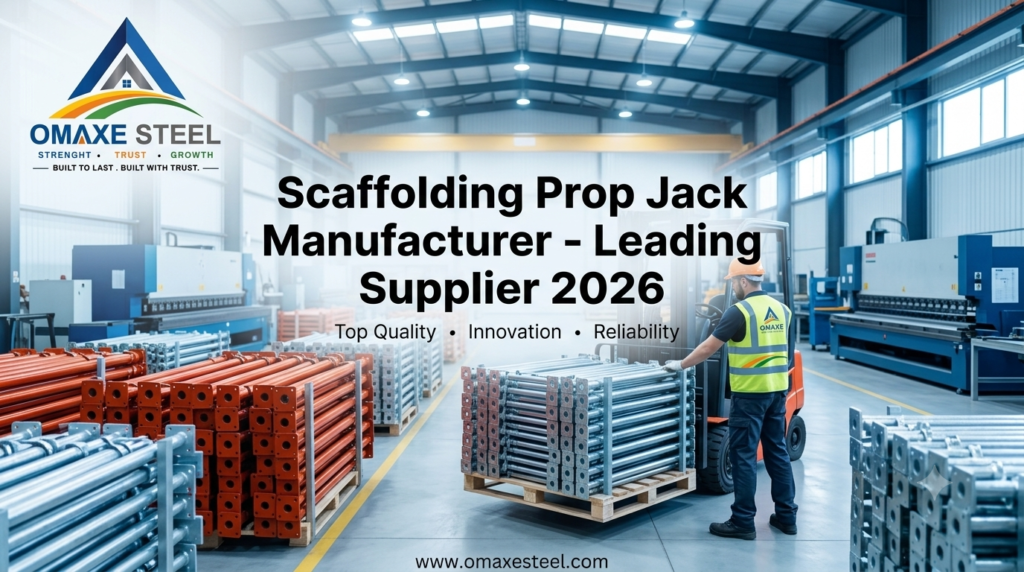
This is the space Omaxe Steel has built its reputation in. Operating from its manufacturing unit in Sahibabad, Ghaziabad (Uttar Pradesh), Omaxe Steel has positioned itself as a leading Scaffolding Prop Jack Manufacturer serving builders across Delhi NCR and the wider Indian construction market. In this article, we take a detailed, practical look at scaffolding prop jacks, what they are, how they work, the types available, the standards they must meet, and why Omaxe Steel continues to be the preferred choice for engineers and contractors in 2026.
What Is a Scaffolding Prop Jack?
A scaffolding prop jack, also known as an adjustable steel prop, telescopic prop, or shuttering prop jack, is a vertical support device used in construction to hold up formwork, slabs, beams, and columns while concrete cures. It typically consists of an outer steel tube and an inner sliding tube, connected through a threaded collar or locking pin mechanism that allows the height to be adjusted precisely on site.
Unlike traditional wooden props, which require manual cutting, wedging, and nailing, steel prop jacks are reusable, quick to install, and far more consistent in the load they can bear. This makes them indispensable across almost every type of concrete construction project, from small residential builds to large-scale infrastructure works.
Core Components of a Prop Jack
- Outer Tube – The larger diameter steel tube that forms the base of the prop.
- Inner Tube – The sliding tube that extends or retracts to change the overall height.
- Adjustment Nut / Collar – Allows fine height adjustment and locks the prop firmly in place.
- Base Plate – Provides a stable footing and distributes load evenly onto the ground or slab.
- U-Head / Top Plate – Supports the horizontal beam, plank, or formwork panel resting on the prop.
Understanding these components helps buyers evaluate quality more effectively, a topic we will return to later in this article.
Why the Right Manufacturer Matters More Than the Product Itself
It is tempting to think of a prop jack as a simple commodity, but in practice, the manufacturer behind the product determines almost everything that matters: the grade of steel used, the accuracy of the threading, the strength of the weld joints, and the consistency of the base plate thickness. A prop jack that looks identical to another on the surface can behave very differently under a real construction load if manufacturing tolerances are not tightly controlled.
This is why experienced contractors increasingly research the manufacturer’s credibility years in business, testing practices, raw material sourcing, and after-sales support rather than comparing products on appearance alone. Omaxe Steel has built its process around exactly these concerns, which we explore in the sections below.
Omaxe Steel: A Trusted Name in Scaffolding Prop Jack Manufacturing
Located at Plot No. 139, Gate No. 1, Metro Pillar 167, Prakash Industrial Estate, Sahibabad, Ghaziabad, Uttar Pradesh, Omaxe Steel operates as a dedicated manufacturing unit for scaffolding and formwork support equipment, serving customers across Ghaziabad, Delhi, Noida, Gurugram, and other fast-growing construction hubs in North India.
The company’s approach centers on four operating principles that guide every batch of prop jacks leaving the facility:
1. Quality Assured Products
Every prop jack manufactured at Omaxe Steel passes through a structured quality check before it reaches a customer. Raw steel is inspected for grade consistency, and finished props are checked for straightness, thread accuracy, and load-bearing stability. This attention to detail reduces on-site failures and extends the working life of the equipment.
2. Advanced Manufacturing
Omaxe Steel utilizes modern cutting, threading, and welding equipment to maintain dimensional accuracy across every prop jack produced. This reduces variation between units — an important factor for contractors who need dozens or hundreds of identical props to work together on a single slab pour.
3. Dedicated Customer Support
From the first enquiry to post-delivery service, Omaxe Steel maintains a responsive support system to help customers select the right prop type, size, and quantity for their specific project requirements. This hands-on guidance is particularly valuable for first-time buyers or smaller contractors unfamiliar with technical specifications.
4. Timely Project Delivery
Construction schedules rarely allow for delays. Omaxe Steel structures its production and dispatch planning around meeting committed delivery timelines, helping site engineers avoid costly downtime caused by equipment shortages.
Together, these principles reflect a manufacturing philosophy built around reliability first, an approach that has helped Omaxe Steel earn repeat business from contractors across the region.
Types of Scaffolding Prop Jacks Offered by Omaxe Steel
Not every construction project requires the same kind of support. Height requirements, load conditions, and formwork design all influence which type of prop jack is appropriate. Omaxe Steel manufactures a wide range of prop jack variants to match these differing site conditions.
| Type of Prop Jack | Description | Common Application |
| Adjustable Steel Prop (Standard) | Telescopic prop with outer and inner tube, adjustable via a threaded collar | General slab and beam support in residential and commercial buildings |
| U-Head Prop Jack | Fitted with a U-shaped top plate to hold timber or steel beams securely | Beam and girder formwork support |
| Base Plate Prop Jack | Features a flat base plate for stable footing on hard or semi-hard surfaces | Ground-level and lower-floor slab casting |
| Heavy-Duty Prop Jack | Thicker wall tubing designed for higher load-bearing requirements | High-rise buildings, bridges, and industrial structures |
| Light-Duty Prop Jack | Lighter tube construction for lower load applications | Residential and small-span slabs |
| T-Type and L-Type Props | Specialized head configurations for specific formwork geometries | Column and wall shuttering systems |
This range allows Omaxe Steel to serve everyone from individual home builders to large infrastructure contractors from a single, dependable supply source.
Technical Specifications: What to Check Before You Buy
When evaluating a scaffolding prop jack manufacturer, technical specification sheets tell you far more than marketing language ever will. Below is a general specification reference that reflects the type of detail a reputable manufacturer like Omaxe Steel provides to customers before purchase.
| Specification | Typical Range / Standard |
| Material | Mild Steel (MS) / Carbon Steel |
| Tube Diameter | 48mm – 60mm (outer tube), varies by model |
| Wall Thickness | 2.5mm – 4mm depending on duty class |
| Adjustable Height Range | 2 meters – 6 meters (model dependent) |
| Base Plate Size | 120mm x 120mm – 150mm x 150mm |
| Surface Finish | Painted / Powder-coated / Galvanized (as per order) |
| Load-Bearing Capacity | Varies by duty class heavy-duty models support significantly higher loads than light-duty models |
| Locking Mechanism | Threaded collar with pin-lock system |
Note: Exact specifications vary by project requirement and are customized based on customer drawings and load calculations. Buyers are encouraged to confirm exact technical parameters directly with the manufacturer before placing bulk orders.
Industry Standards and Quality Benchmarks
A dependable prop jack is not just about steel and welding it is about conformity to recognized construction industry benchmarks. While specific certification status should always be confirmed directly with the manufacturer, reputable Indian scaffolding manufacturers generally align their manufacturing practices with the following reference frameworks:
| Standard / Reference | Relevance to Prop Jacks |
| IS 1239 (Indian Standard) | Governs specifications for steel tubes used in scaffolding and structural applications |
| IS 4014 | Relates to design and safety of steel props used in formwork |
| BS 1139 (British Standard) | International reference standard for scaffolding tube specifications |
| EN 74 | European standard for scaffold couplers and fittings, often referenced for prop accessories |
Manufacturers who structure their production around these frameworks tend to produce more consistent, safer, and longer-lasting equipment, a key reason experienced contractors ask specifically about standard compliance before finalizing a supplier.
Steel Props vs. Timber Props: Why the Industry Has Shifted
Older construction practices relied heavily on timber for shoring and formwork support. While wood is still used in some regions, most contractors have moved toward steel prop jacks for several practical reasons:
| Factor | Timber Props | Steel Prop Jacks |
| Reusability | Limited, degrades with repeated use | High, can be reused across many projects |
| Height Adjustment | Requires manual cutting and wedging | Simple threaded or pin-lock adjustment |
| Labor Requirement | Higher, due to cutting and fitting | Lower, faster installation |
| Consistency of Load-Bearing | Variable, depends on wood quality | Consistent, based on manufactured specification |
| Long-Term Cost Efficiency | Lower upfront but higher recurring cost | Higher upfront but lower cost over multiple projects |
| Weather Resistance | Prone to warping and rot | Resistant when properly coated or galvanized |
This shift toward steel has directly increased demand for manufacturers who can supply consistent, well-engineered prop jacks at scale, a gap Omaxe Steel has worked to fill for builders across North India.
Manufacturing Process: How a Quality Prop Jack Is Made
Understanding how a prop jack is produced helps buyers appreciate why manufacturing quality varies so widely between suppliers. A typical production process, as followed at facilities like Omaxe Steel, includes the following stages:
- Raw Material Selection – Steel tubes and plates are sourced and checked for grade consistency before entering production.
- Cutting to Length – Tubes are cut to precise lengths according to the required prop model and height range.
- Threading and Drilling – Adjustment collars, pin holes, or threaded sections are machined with close tolerance to ensure smooth, reliable operation on site.
- Welding of Base Plates and Heads – Base plates and U-heads or top plates are welded onto the tube ends, with weld quality checked for strength and finish.
- Surface Treatment – Depending on the order, props are painted, powder-coated, or galvanized to resist rust and extend service life.
- Quality Inspection – Finished props are inspected for straightness, smooth telescopic movement, and overall build quality before packing.
- Packing and Dispatch – Props are bundled and prepared for transport, with dispatch planning aligned to the customer’s project schedule.
Each of these stages directly affects how the prop jack performs on-site which is why manufacturers with strong in-house control over the entire process, rather than those simply assembling bought-in parts, tend to deliver more consistent results.
Safety and Maintenance Tips for Scaffolding Prop Jacks
Even the best-manufactured prop jack needs to be used and maintained correctly to perform safely over its lifespan. Some practical guidelines followed on well-managed construction sites include:
- Inspect Before Use – Check for bent tubes, damaged threads, or worn base plates before every use.
- Avoid Overloading – Always use the prop jack within its rated load-bearing capacity for the specific duty class.
- Ensure Vertical Alignment – Props should be installed perfectly vertical to distribute load correctly and avoid buckling risk.
- Use on Stable Ground – Base plates should rest on firm, level surfaces, using additional support boards on soft ground if needed.
- Store Properly – Keep props stacked and stored away from moisture when not in use to prevent corrosion.
- Replace Worn Components – Damaged locking pins, collars, or base plates should be replaced promptly rather than continuing use with compromised parts.
Following these practices not only extends the working life of the equipment but also plays a direct role in maintaining site safety standards.
Serving Delhi NCR and Beyond
Omaxe Steel’s manufacturing base in Sahibabad, Ghaziabad places it within convenient reach of some of India’s busiest construction corridors, including Ghaziabad, Noida, Greater Noida, Delhi, Gurugram, Faridabad, and other rapidly developing towns across Uttar Pradesh and the National Capital Region. This central location supports efficient dispatch planning, helping contractors in these areas receive their prop jack orders without the delays often associated with sourcing from distant suppliers.
For contractors managing multiple sites across the region, working with a single, locally accessible manufacturer also simplifies logistics, communication, and after-sales support advantages that become increasingly valuable as project timelines tighten.
Applications of Scaffolding Prop Jacks Across Industries
The versatility of the prop jack is one of its greatest strengths. Below are some of the primary sectors where Omaxe Steel’s prop jacks are put to work:
Residential Construction
From independent houses to multi-storey apartment buildings, prop jacks support slab and beam formwork until concrete achieves sufficient curing strength.
Commercial and Institutional Buildings
Office complexes, shopping centers, schools, and hospitals rely on precisely engineered prop systems to manage larger spans and heavier structural loads safely.
Industrial and Warehouse Construction
Industrial sheds and warehouses often involve wide-span slabs and roofing systems that require heavy-duty prop configurations for safe load distribution during construction.
Infrastructure Projects
Bridges, flyovers, metro corridors, and other infrastructure works frequently use heavy-duty and specialized prop jack variants engineered for higher load tolerances.
Renovation and Repair Work
Prop jacks are equally valuable during renovation, providing temporary support to existing structural elements while repair or reinforcement work is carried out.
How to Choose the Right Scaffolding Prop Jack Manufacturer
With multiple suppliers in the market, selecting the right manufacturer can feel overwhelming. Here is a practical checklist drawn from how experienced site engineers approach this decision:
- Verify Material Quality – Ask for the steel grade being used and, where possible, request test certificates.
- Check Manufacturing Facility Capability – A manufacturer with in-house cutting, threading, and welding capability typically offers better consistency than a trader reselling third-party stock.
- Review Product Range – A manufacturer offering multiple duty classes and head configurations can support a wider range of project needs from one source.
- Ask About Customization – Projects with unique height or load requirements benefit from a manufacturer willing to produce custom specifications.
- Evaluate Delivery Reliability – Site schedules depend on equipment arriving on time; ask about typical lead times for bulk orders.
- Assess After-Sales Support – A responsive manufacturer helps resolve technical queries and replacement needs quickly.
- Consider Location and Logistics – A manufacturer based centrally, such as Omaxe Steel in Ghaziabad, can offer faster dispatch across the Delhi NCR region compared to distant suppliers.
Omaxe Steel is structured to meet each of these criteria, combining in-house manufacturing control with a customer-first approach to specification and delivery planning.
Why Contractors Across Delhi NCR Choose Omaxe Steel
| Factor | What Omaxe Steel Offers |
| Manufacturing Control | In-house production with quality checks at each stage |
| Product Range | Multiple prop types and duty classes under one roof |
| Location Advantage | Centrally located in Ghaziabad (UP), enabling efficient dispatch across Delhi NCR |
| Customer Guidance | Dedicated support to help buyers choose the correct specification |
| Delivery Discipline | Structured planning to meet committed project timelines |
| Long-Term Reliability | Focus on repeat business built through consistent product performance |
This combination of manufacturing discipline and customer-focused service is what continues to set Omaxe Steel apart as builders plan their 2026 construction pipelines.
(FAQs)
Q1. What is the main function of a scaffolding prop jack?
A scaffolding prop jack provides temporary vertical support to formwork, slabs, beams, and columns during the concrete curing process, ensuring the structure remains stable until it can bear its own load.
Q2. How do I know which prop jack duty class I need?
The appropriate duty class depends on the load the prop will bear, the span of the slab or beam, and the height required. A manufacturer’s technical team, such as Omaxe Steel’s support staff, can help calculate the right specification based on your project drawings.
Q3. Can prop jacks be customized for non-standard heights?
Yes. Many manufacturers, including Omaxe Steel, offer customized height ranges and base plate sizes to match specific project requirements.
Q4. What is the typical material used in manufacturing prop jacks?
Most prop jacks are manufactured from mild steel or carbon steel tubing, chosen for its strength, weldability, and durability under repeated use.
Q5. Are prop jacks reusable across multiple projects?
Yes, this is one of the key advantages of steel prop jacks over timber props. With proper maintenance and storage, a well-manufactured prop jack can be reused across numerous projects over its service life.
Q6. How does Omaxe Steel ensure delivery timelines are met?
Omaxe Steel plans production and dispatch schedules around confirmed order timelines, helping ensure contractors receive equipment in line with their site planning needs.
About the Writer
Author Insight
This article has been reviewed and structured with technical input from an industry professional with direct experience in the scaffolding and steel fabrication sector.
Mr. Tarun Barleja An experienced voice in the steel and scaffolding manufacturing industry, Mr. Tarun Barleja brings hands-on, practical knowledge of formwork support systems, manufacturing processes, and site-level equipment requirements to this article. His insights are shaped by close engagement with contractors, engineers, and manufacturing operations in the Delhi NCR construction ecosystem.
Address: Plot No. 139, Gate No. 1, Metro Pillar 167, Prakash Industrial Estate, Sahibabad, Ghaziabad, Uttar Pradesh, India Email: vstamit.139@gmail.com Phone: +91-9891999139
For technical queries, bulk order requirements, or custom prop jack specifications, readers are welcome to reach out directly through the contact details above.
Summary
Scaffolding prop jacks are a foundational piece of equipment in modern construction, providing the vertical support needed to hold formwork and structural elements in place while concrete cures. Choosing the right type whether standard adjustable, U-head, base plate, or heavy-duty depends on the specific load, height, and application of a project.
Beyond the product itself, the manufacturer behind it plays a decisive role in determining safety, consistency, and long-term value. Factors like material quality, manufacturing precision, adherence to recognized standards, product range, and delivery reliability separate dependable suppliers from the rest.
Omaxe Steel, based in Sahibabad, Ghaziabad, has built its reputation around exactly these fundamentals: quality-assured manufacturing, an advanced production process, dedicated customer support, and a strong track record of timely delivery. These qualities have made it a preferred Scaffolding Prop Jack Manufacturer for contractors and builders across Delhi NCR heading into 2026.
Conclusion
As construction activity continues to grow across India in 2026, the equipment supporting that growth needs to be just as dependable as the buildings it helps create. A scaffolding prop jack may be a small component in the larger picture of a construction project, but its role in ensuring structural safety during the critical curing phase cannot be overstated.
For contractors and builders searching for a Scaffolding Prop Jack Manufacturer that combines quality, technical support, and reliable delivery, Omaxe Steel offers a manufacturing partnership built on consistency and trust. Whether the requirement is a small residential slab or a large-scale infrastructure project, having the right prop jack from the right manufacturer makes all the difference between a smooth construction timeline and costly on-site delays.
For enquiries, specifications, or bulk order requirements, contact Omaxe Steel at Plot No. 139, Gate No. 1, Metro Pillar 167, Prakash Industrial Estate, Sahibabad, Ghaziabad (UP), or reach out via email at vstamit.139@gmail.com or phone at +91-9891999139.