Proper electrical earthing is one of the most important — and most overlooked — parts of any industrial, commercial, infrastructure or residential electrical installation. It protects equipment, structures and, most importantly, people from the risks associated with electrical faults. At the centre of any grounding system is the earthing strip, a conductive component that provides a path through the grounding network to help safely carry fault current toward earth.
Among the different materials available, GI Earthing Strips are one of the most commonly used, largely because galvanized iron combines useful mechanical strength with a protective layer against corrosion. But how does a raw steel strip actually become a durable GI earthing strip suitable for electrical grounding applications? Understanding Earthing Strip Manufacturing — from raw material selection to galvanization and final inspection — helps contractors, engineers and procurement teams make better sourcing decisions.
In this article, we walk through the manufacturing process, the materials commonly used, the quality factors that matter, and how to select a dependable manufacturer for Earthing Strip Manufacturing in India.
What is an Earthing Strip?
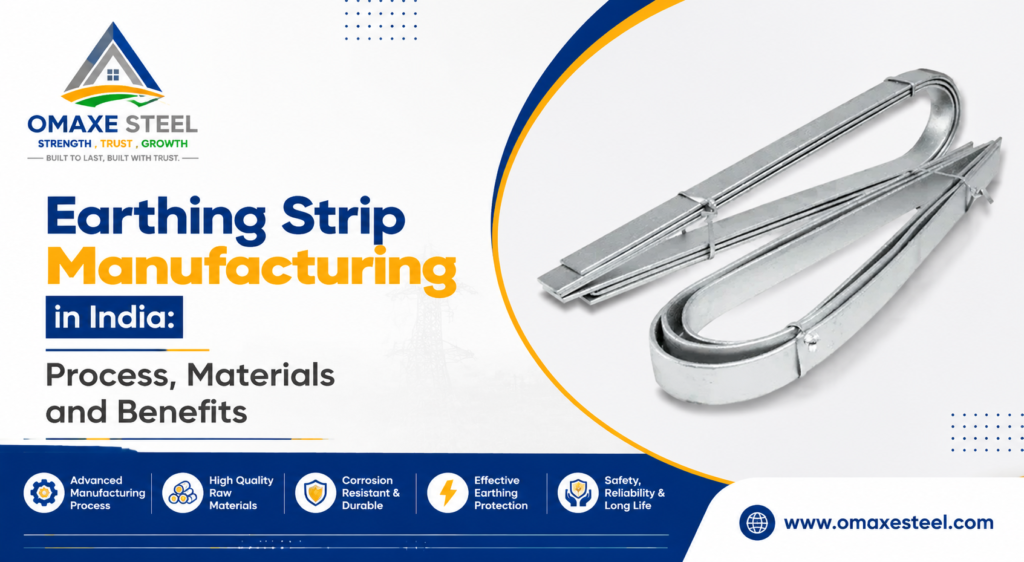
An earthing strip is a flat, elongated conductive material used to connect electrical equipment, structures, panels or earthing electrodes to a grounding system. Its core function is to support the safe dissipation of fault current into the ground, reducing the risk of dangerous voltage build-up on equipment or structures during a fault condition.
Earthing strips are used across:
- Electrical grounding systems
- Fault-current dissipation paths
- Equipment grounding
- Earthing grids
- General electrical installations
- Industrial grounding networks
It’s worth noting that an earthing strip is one component within a larger, engineered grounding system. It works alongside electrodes, earthing pipes, connectors and proper installation practices — it does not, on its own, guarantee electrical safety. The overall system design, following applicable electrical standards, determines how effective the grounding truly is.
Why Are GI Earthing Strips Widely Used?
Galvanized Iron (GI) is a popular choice for earthing strips for several practical reasons:
- Mechanical strength suitable for handling and installation
- Corrosion resistance provided by the zinc coating
- Durability across varied site conditions
- Suitability for outdoor installations
- Suitability for underground applications where appropriate to the project
- Relative ease of fabrication into required sizes
- Availability in a range of dimensions
- Practicality for large grounding networks that need consistent material across many points
Galvanization works by applying a zinc coating over the steel surface, which helps protect the underlying metal from environmental exposure. It’s important to note that galvanization improves corrosion resistance — it does not make the material corrosion-proof, and its performance depends on installation conditions, environmental exposure and maintenance over time.
Earthing Strip Manufacturing Process in India
Earthing Strip Manufacturing typically follows a structured sequence of steps designed to produce a consistent, reliable finished product. Here’s a general overview of how the process works.
1. Raw Material Selection
The process begins with selecting suitable steel or iron material according to the required dimensions and project specifications. Consistency in material thickness, width, mechanical properties and surface condition at this stage directly affects the quality of the finished strip, so manufacturers pay close attention to sourcing uniform raw material.
2. Cutting and Slitting
The steel material is then cut or slit into the required strip widths. Accurate width, uniform edges and dimensional consistency are important not just for a clean finished product, but also to reduce material wastage during production.
3. Straightening and Forming
Strips are straightened and processed to achieve consistent dimensions and shape. Uneven or distorted material can create real difficulties during installation, particularly on large grounding networks where strips need to align predictably.
4. Surface Preparation
Before galvanization, surface contaminants such as oil, dirt, rust and scale need to be removed. This generally involves cleaning and pickling processes that prepare the steel surface so the zinc coating can bond properly during galvanization.
5. Galvanization
This is a defining step in GI Earthing Strip production. The steel is coated with zinc, and this layer helps:
- Protect the base metal against rust
- Improve overall corrosion resistance
- Increase suitability for harsher environmental conditions
- Support long-term durability of the strip
The exact coating parameters used by a manufacturer should be confirmed directly with them and matched against project or standard requirements where applicable.
6. Cooling and Finishing
After galvanizing, strips are cooled and finished, with a visual check carried out to identify any surface irregularities before the material moves forward for inspection.
7. Dimensional Inspection
At this stage, manufacturers check width, thickness, length, straightness and surface condition to confirm the strip meets the required specifications before it is approved for dispatch.
8. Packaging and Dispatch
Finally, earthing strips are packed in a form suitable for transportation and project requirements. Omaxe Steel, for instance, lists its GI Earthing Strip with customizable length and coil or bundle packaging, allowing buyers to choose an option that fits their project logistics.
Materials Used for Manufacturing Earthing Strips
GI Earthing Strip
Galvanized iron strips are widely used across industrial, commercial and infrastructure projects because of their balance of strength, corrosion protection and cost-effectiveness.
Copper Earthing Strip
Copper offers strong electrical conductivity and natural corrosion resistance, making it suitable for specialised or high-performance grounding applications. It typically comes with different cost considerations compared to GI, so project budgets and technical requirements both play a role in the decision.
Mild Steel Earthing Strip
MS strips are also used in certain applications, though they may require additional corrosion protection depending on installation conditions and environmental exposure.
The right material should always be selected based on soil conditions, environmental exposure, electrical system design, corrosion risk, project specifications, budget and applicable standards — not on a single factor alone.
GI Earthing Strip vs Copper Earthing Strip
| Factor | GI Earthing Strip | Copper Earthing Strip |
| Base Material | Galvanized steel/iron | Copper |
| Corrosion Protection | Zinc coating | Natural corrosion resistance |
| Conductivity | Suitable for many grounding applications | Higher electrical conductivity |
| Cost | Generally more economical | Generally more expensive |
| Applications | Industrial, commercial and infrastructure projects | Specialised and high-performance grounding applications |
| Selection | Based on project specification | Based on project specification |
Neither material is universally “better” — the right choice depends on the electrical system design and site requirements, and this decision is best made by the electrical engineer or consultant responsible for the project.
Important Quality Factors in Earthing Strip Manufacturing
1. Material Quality — Uniform, suitable raw material forms the foundation of a reliable strip.
2. Correct Dimensions — Consistent thickness, width and length matter for both performance and installation.
3. Galvanizing Quality — A uniform protective coating with proper surface coverage is essential.
4. Surface Finish — The strip should be free of major defects that could compromise installation or corrosion protection.
5. Mechanical Strength — Material should be suitable for the handling and installation conditions it will face.
6. Dimensional Accuracy — Important for matching project installation and engineering specifications.
7. Quality Inspection — Should take place before dispatch to confirm the product meets required specifications.
Benefits of High-Quality GI Earthing Strips
- Reliable grounding connection
- Corrosion resistance from the zinc coating
- Mechanical strength suited to industrial use
- Long-term durability
- Suitability for both indoor and outdoor systems
- Flexible installation across different layouts
- Availability in project-specific lengths
- Practical for use across large grounding networks
- Reduced corrosion-related maintenance compared with unprotected steel
Applications of GI Earthing Strips
Industrial Plants — Earthing of machinery, electrical systems and industrial infrastructure.
Electrical Substations — Grounding networks and electrical installations.
Commercial Buildings — Electrical grounding systems for large buildings.
Residential Projects — Earthing infrastructure for suitable electrical installations.
Solar Power Projects — Grounding systems used around solar electrical infrastructure.
Telecommunication Towers — Grounding of tower structures and associated electrical equipment.
Power Distribution Systems — Use within appropriately engineered grounding networks.
Infrastructure Projects — Electrical and engineering projects requiring durable earthing materials.
Why Corrosion Resistance Matters in Earthing Strips
Earthing materials are frequently exposed to moisture, soil, rainwater, humidity, outdoor environments and industrial conditions. Over time, corrosion can gradually reduce the effective cross-section and overall condition of metal components, which is why corrosion protection is such an important consideration in Earthing Strip Manufacturing.
Galvanization helps address this by providing a protective zinc coating that helps reduce corrosion of the underlying steel. That said, the level of protection depends on coating quality, installation environment and ongoing maintenance — it’s a meaningful improvement over untreated steel, not an absolute guarantee against corrosion.
How to Select the Right Earthing Strip
Buyers and project teams should consider:
- Material type (GI, copper or MS)
- Required width
- Required thickness
- Required length
- Electrical system design
- Fault-current requirements
- Installation environment
- Soil conditions
- Corrosion exposure
- Project specifications
- Applicable electrical standards
- Quantity required
Sharing complete technical specifications with the manufacturer before placing an order helps ensure the supplied material matches actual project needs.
Standard vs Custom Length Earthing Strips
Projects vary in layout, scale and installation approach, which is why different lengths of earthing strip are often required. Customized lengths can offer real advantages:
- Easier project planning
- Reduced unnecessary joints
- Reduced material wastage
- Better installation efficiency
- Suitability for project-specific layouts
Omaxe Steel’s GI Earthing Strip is offered with customizable length, helping buyers align material supply with their specific project layout.
Coil vs Bundle Packaging for Earthing Strips
Coil Packaging is generally suited to continuous lengths and can offer convenient transport depending on the strip’s dimensions and project requirements.
Bundle Packaging supports organised handling and transportation of straight or project-specific strip lengths.
Omaxe Steel lists coil or bundle packaging for its GI Earthing Strip, giving buyers flexibility based on their site and logistics needs.
Earthing Strip Manufacturing for Industrial Projects
Large industrial projects often require consistent materials across multiple installation points, which adds a layer of complexity to procurement. Key considerations include:
- Large quantities
- Uniform dimensions across batches
- Consistent surface protection
- Customized requirements
- Timely supply
- Project scheduling
- Logistics coordination
- Quality consistency
Working directly with an experienced manufacturer or supplier can simplify this process, reducing the coordination burden on contractors and project teams.
How to Choose an Earthing Strip Manufacturer in India
When evaluating a manufacturer, look for one that offers:
- Suitable GI material
- Consistent dimensions
- Reliable galvanization
- Custom sizing capability
- Industrial-scale supply
- Multiple earthing products
- Quality inspection before dispatch
- Packaging options suited to your logistics
- Technical product support
- Reliable delivery timelines
- Experience serving industrial projects
Before finalising a supplier, request specifications and quotations based on your actual project requirements rather than relying on generic listings.
Why Choose Omaxe Steel for GI Earthing Strips?
Omaxe Steel Equipments is a manufacturer, supplier, trader and service provider established in 2013, serving the Indian market from its base in Sahibabad, Ghaziabad, Uttar Pradesh. The company offers earthing materials including GI Earthing Strips made from galvanized iron, with customizable strip length and coil or bundle packaging to suit different project needs.
Beyond earthing strips, Omaxe Steel also supplies GI Earthing Pipes, GI Earthing Plates and other earthing materials as part of a broader industrial and construction product range, positioning the company as a practical option for industrial and infrastructure earthing requirements. For project-specific queries, buyers can Contact Omaxe Steel with their required specifications.
Other Earthing Materials Used with Earthing Strips
A complete grounding system typically involves more than just the strip itself. Related products available from Omaxe Steel include:
- GI Earthing Pipe
- Galvanized Iron Earthing Pipe
- Galvanized Iron Earthing Plate
- Copper Earthing Electrode
- Copper Earthing Plate
- Earthing Coal
- Earthing Salt
- Earthing Funnel
The complete earthing system should be selected according to the electrical design and site requirements, with each component — from the GI Earthing Strip to the earthing electrode — playing a specific role in the overall grounding network.
Common Mistakes to Avoid When Buying Earthing Strips
- Selecting only on the basis of lowest price
- Ignoring material thickness requirements
- Not verifying actual dimensions supplied
- Overlooking galvanizing quality
- Purchasing the wrong material for the application
- Not considering soil conditions
- Ordering without clear project specifications
- Using undersized material
- Ignoring installation environment conditions
- Choosing unverified or unreliable suppliers
Technical selection should always follow electrical engineering requirements rather than assumptions or price alone.
Earthing Strip Manufacturer in Ghaziabad Serving Projects Across India
For contractors and buyers searching for an Earthing Strip Manufacturer in Ghaziabad, Omaxe Steel Equipments operates from Sahibabad, Ghaziabad, Uttar Pradesh, and serves customers across the Indian market. As a GI Earthing Strip Manufacturer in Ghaziabad and broader Earthing Strip Supplier in India, the company works with industrial, commercial and infrastructure projects that require dependable Earthing Material Manufacturer in India support — from initial specification discussions through to supply and dispatch.
Conclusion
Quality Earthing Strip Manufacturing depends on several factors working together: suitable raw material, accurate dimensions, proper surface preparation, effective galvanization, careful quality inspection, correct packaging and application-specific material selection. GI earthing strips, in particular, offer a practical combination of strength, corrosion protection and installation flexibility that suits many electrical grounding projects across industrial, commercial and infrastructure sectors.
Omaxe Steel Equipments offers GI Earthing Strips and related earthing materials designed to support these grounding requirements across India.
Looking for GI Earthing Strips for your electrical, industrial or infrastructure project? Share your required width, thickness, length, quantity and application with Omaxe Steel Equipments to get suitable product details and a quotation.
FAQs
1. What is an earthing strip used for?
An earthing strip provides a conductive path within an electrical grounding system, helping carry fault current safely toward earth. It’s used to connect equipment, structures or panels to the overall grounding network as part of a properly engineered electrical installation.
2. How are GI earthing strips manufactured?
Manufacturing typically involves selecting suitable raw material, cutting and slitting to the required width, straightening, surface preparation, galvanization with zinc, cooling and finishing, dimensional inspection, and finally packaging for dispatch based on project requirements.
3. Which material is commonly used for earthing strips?
GI (galvanized iron), copper and mild steel are all used, depending on the project. GI is common for its balance of strength and corrosion protection, copper for higher conductivity applications, and MS where additional protection can be arranged separately.
4. Why is galvanization important for an earthing strip?
Galvanization applies a zinc coating over the steel surface, which helps protect the underlying metal against corrosion. This improves the strip’s suitability for outdoor, underground and industrial environments compared to untreated steel, supporting longer-term durability.
5. What is the difference between GI and copper earthing strips?
GI strips use zinc-coated steel and are generally more economical, suited to a wide range of industrial and infrastructure projects. Copper strips offer higher conductivity and natural corrosion resistance but typically come at a higher cost, often used in specialised applications.
6. Can GI earthing strips be supplied in custom lengths?
Yes. Omaxe Steel lists its GI Earthing Strip with customizable length options, allowing buyers to match material supply to their specific project layout and reduce unnecessary joints or wastage during installation.
7. Where are GI earthing strips commonly used?
They’re used in electrical substations, industrial plants, commercial buildings, residential projects, solar power installations, telecommunication towers and power distribution systems, wherever a properly engineered grounding network is required.
8. Where can I buy GI Earthing Strips in Ghaziabad?
Omaxe Steel Equipments, based in Sahibabad, Ghaziabad, manufactures and supplies GI Earthing Strips along with related earthing materials across India. Interested buyers can share their project specifications directly with the company to receive suitable product details and a quotation.