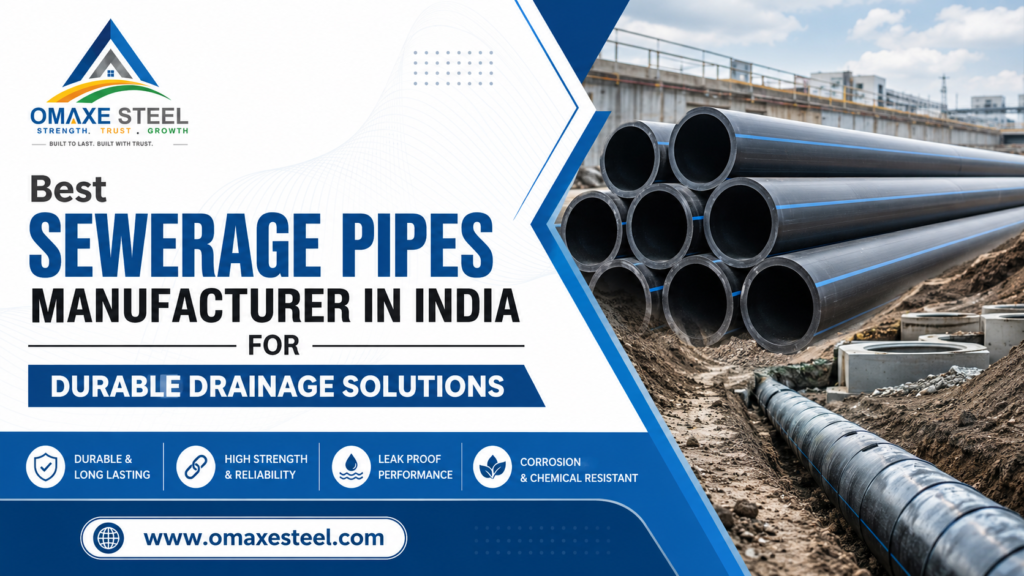
Every drainage system is only as good as the pipe running beneath it. Whether it is a housing society, a factory, a hospital, or a stretch of municipal road, the sewerage pipe carrying wastewater away from that site has to work quietly and reliably for decades. Choose the wrong one, and you are looking at leaks, blockages, foul odours, and repeated digging-up of freshly laid roads. Choose right, and the drainage network practically takes care of itself.
This is why builders, contractors, and infrastructure companies across India spend real time evaluating a sewerage pipes manufacturer before placing an order. It is not just about buying a pipe — it is about buying years of trouble-free wastewater management, structural durability underground, and lower maintenance costs over the life of the project. In this article, we will walk through what sewerage pipes actually do, why quality matters so much, how to choose the right one, and how Omaxe Steel Equipments fits into this picture for buyers looking for a dependable supply partner.
What Are Sewerage Pipes?
Sewerage pipes are the underground pipelines designed to carry sewage, wastewater, and in many cases stormwater away from buildings and townships to treatment plants or municipal disposal points. They form the backbone of any sanitation and drainage network — invisible once installed, but critical to how a site functions every single day.
Their basic job sounds simple: move wastewater from point A to point B without leaking, without collapsing under soil load, and without letting solids settle and choke the line. In practice, this requires the pipe to handle constant exposure to moisture, chemicals in wastewater, ground pressure, and — depending on depth and location — vehicle or building loads from above. A well-designed sewerage pipe keeps sanitation systems working safely, protects groundwater from contamination, and reduces the health risks that come with poor wastewater disposal. In modern Indian infrastructure, from smart city projects to housing developments, reliable sewerage piping is treated as a core utility, not an afterthought.
Why Quality Sewerage Pipes Matter
Not all pipes marketed for drainage perform the same way once buried underground. The difference between an average pipe and a genuinely good one becomes obvious a few years into use — usually at the worst possible time. Here is what separates a dependable sewerage pipe from a problematic one:
- Long service life – A well-made pipe should last for decades without needing replacement, saving on the cost and disruption of digging up installed lines.
- Leak-resistant joints – Weak joints are one of the most common causes of underground leakage, soil contamination, and gradual pipe failure.
- Structural strength – The pipe has to bear soil pressure, traffic loads, and sometimes building loads without cracking or deforming.
- Resistance to corrosion and chemicals – Wastewater is rarely just water; it carries chemicals, grease, and organic waste that can degrade weaker materials over time.
- Underground load resistance – Pipes installed at varying depths need to hold their shape under constant ground pressure.
- Smooth wastewater flow – A smooth internal surface reduces friction loss and keeps solids from settling and building up inside the pipe.
- Reduced maintenance and blockage risks – Good pipe design directly cuts down on the frequency of clogging, backflow, and emergency repairs.
Contractors who cut corners on pipe quality to save on upfront cost often end up paying far more later in repairs, re-excavation, and project delays.
Applications of Sewerage Pipes
Sewerage pipes are used well beyond the obvious municipal drainage line. Typical applications include:
- Residential developments and gated communities
- Commercial buildings and office complexes
- Industrial facilities with process wastewater
- Municipal sewerage networks and public drainage systems
- Housing societies and integrated townships
- Hospitals and educational institutions, where hygiene standards are critical
- Hotels and shopping complexes with high daily wastewater volumes
- Large infrastructure projects, including highways, railways, and smart city developments
- Combined stormwater and wastewater drainage systems
Each of these settings puts slightly different demands on the pipe — a hospital’s drainage line has different hygiene and reliability expectations than a highway’s stormwater channel, even though both fall under the broad category of sewerage piping.
How to Choose the Right Sewerage Pipe
Selecting a sewerage pipe is a technical decision, not a generic purchase. Buyers and site engineers typically evaluate the following before finalising an order:
- Pipe diameter – Based on expected wastewater or stormwater volume for the site.
- Flow requirements – Peak load conditions, especially for commercial and municipal projects.
- Installation depth – Deeper installations face higher soil pressure and need pipes rated accordingly.
- Soil conditions – Soil type and moisture levels affect how a pipe performs over time.
- Load-bearing requirements – Traffic-bearing areas need pipes built for higher external load.
- Joint quality – Reliable jointing systems prevent leakage at connection points, which is where most failures start.
- Material durability – The pipe material should hold up to the specific chemical and moisture exposure of the project.
- Project specifications – Government and infrastructure projects often come with defined technical requirements that the pipe must match.
- Manufacturer or supplier reliability – A dependable supply partner matters as much as the product itself, especially for large or phased projects.
Important Features to Look for in Sewerage Pipes
When comparing options from different suppliers, these are the features worth checking closely:
- Structural strength for underground and load-bearing conditions
- Corrosion resistance for long-term underground exposure
- Chemical resistance suited to wastewater composition
- A smooth internal surface that minimises blockage risk
- Strong, reliable joints that prevent leakage over time
- Lightweight handling where the material allows it, easing transport and installation
- Proven durability specifically for underground installation
- Availability across different sizes and specifications to match varied project needs
Sewerage Pipes for Different Projects
Sewerage pipe requirements are not one-size-fits-all. A residential housing project usually needs standard-diameter pipes designed for domestic wastewater volumes and relatively shallow installation. Commercial buildings, with higher daily usage and denser occupancy, often require higher-capacity lines and stronger load resistance near parking and access areas.
Industrial facilities bring another layer of complexity — process wastewater may carry chemicals, oils, or higher temperatures, which calls for pipes with stronger chemical resistance. Large infrastructure projects, such as township developments, highways, or municipal upgrades, typically need bulk quantities supplied in phases, along with pipes engineered to handle heavier loads and larger diameters across long stretches. Understanding these differences upfront helps avoid under-specifying a pipe for conditions it was never designed to handle.
Why Choosing a Reliable Sewerage Pipes Manufacturer Matters
The pipe itself is only half the equation — who you buy it from matters just as much. A dependable Sewerage Pipes Manufacturer brings:
- Consistent product quality across every batch and every order
- Genuine material, without shortcuts that compromise long-term performance
- Proper specifications matched accurately to project requirements
- Quality inspection before dispatch, reducing the chance of on-site defects
- Bulk availability for projects that need large volumes on a defined timeline
- Reliable dispatch so installation schedules are not held up
- Technical guidance to help buyers select the right size and type for their site
- Timely project supply, which keeps construction schedules on track
For contractors managing multiple sites, this reliability is often the difference between a smooth project and one full of avoidable delays.
Why Choose Omaxe Steel Equipments for Sewerage Pipes?
Omaxe Steel Equipments is a Ghaziabad-based industrial and steel solutions provider, established in 2013, serving construction, infrastructure, and industrial clients across India. The company positions itself as a manufacturer, supplier, trader, and service provider, working across product lines that include industrial pipes, earthing material, scaffolding systems, and DWC HDPE pipes — a category directly relevant to drainage and sewerage applications.
Within this range, Omaxe Steel’s DWC (Double Wall Corrugated) HDPE pipes are built for underground use in drainage systems, sewer lines, and wastewater networks, alongside applications like cable protection and telecom ducting. These pipes combine a corrugated outer wall for load-bearing strength with a smooth inner wall for efficient, low-friction flow — a structural feature that suits the demands of underground sewerage installation. Omaxe Steel also supplies cast iron manhole covers, which are a standard companion product in sewerage and drainage networks.
The company’s approach centres on consistent product quality, a focus on modern manufacturing and supply systems, and a customer-first service model built around understanding project requirements before recommending a solution. With a stated logistics network aimed at timely, pan-India delivery, Omaxe Steel works with contractors, industries, and infrastructure companies who need dependable supply for ongoing projects rather than a one-time transaction. If you’re evaluating options, their DWC HDPE Pipes range and broader product catalogue are worth a look before finalising your specifications.
How Omaxe Steel Supports Construction and Infrastructure Projects
For contractors, builders, developers, and infrastructure companies, a construction schedule only holds together if material supply keeps pace with it. Omaxe Steel’s role in a drainage or sewerage project is less about a single sale and more about ongoing support — helping buyers work through pipe specifications suited to their site conditions, coordinating supply volumes for phased projects, and maintaining a delivery network that reduces the risk of on-site delays.
This kind of support matters most on projects where drainage work is one part of a larger construction timeline — a delayed pipe delivery can hold up excavation crews, road-laying teams, and inspection schedules that all depend on it. Working with a supplier that understands both the technical side of piping and the practical realities of a construction site helps keep these moving parts aligned. You can explore Omaxe Steel’s full range of industrial pipes and construction materials or get in touch through their contact page for project-specific guidance.
Conclusion
Sewerage pipes may sit out of sight once installed, but the decisions made before they go into the ground shape how well a drainage system performs for years afterward. Diameter, joint quality, material durability, and — just as importantly — the reliability of the supplier all play a role in whether a project runs smoothly or runs into repeated underground problems.
For businesses in India looking for a sewerage pipes manufacturer that understands both the technical requirements of underground drainage and the practical needs of a live construction site, Omaxe Steel Equipments offers a product range built around durability and a supply approach built around project timelines. If you have a drainage or sewerage requirement coming up, reach out to Omaxe Steel with your required pipe size, quantity, application, and project specifications, and their team can guide you toward the right solution or a formal quotation.
Frequently Asked Questions
1. Which is the best sewerage pipes manufacturer in India?
The right manufacturer depends on your project’s pipe size, volume, and specification needs, so it’s worth comparing product quality, supply reliability, and technical support rather than price alone. Omaxe Steel Equipments, based in Ghaziabad, supplies DWC HDPE pipes suited to sewerage and drainage applications along with related infrastructure materials.
2. What are sewerage pipes used for?
Sewerage pipes carry wastewater and, in many systems, stormwater away from buildings and townships to treatment or disposal points. They are used across residential, commercial, industrial, and municipal drainage networks to keep sanitation systems functioning safely and prevent contamination of surrounding land and groundwater.
3. How do I choose the right sewerage pipe for my project?
Start with your project’s flow requirements, pipe diameter, and installation depth, then factor in soil conditions and expected load. Joint quality and material durability matter just as much as size, since weak joints are a common cause of underground leaks. A reliable supplier can help match these factors to your exact site conditions.
4. Are sewerage pipes suitable for underground drainage systems?
Yes, sewerage pipes are specifically engineered for underground installation. Pipes such as DWC HDPE are designed with a corrugated outer wall for load resistance and a smooth inner wall for efficient flow, making them well suited to handle soil pressure, moisture exposure, and long-term underground use in drainage networks.
5. Can sewerage pipes be supplied in bulk for construction projects?
Yes, most manufacturers and suppliers offer bulk supply for construction and infrastructure projects, often coordinated in phases to match site progress. Omaxe Steel Equipments supplies pipes across different sizes and specifications and works with contractors and developers on project-based supply requirements.
6. How can I buy sewerage pipes from Omaxe Steel?
You can reach out to Omaxe Steel Equipments through their contact page or by phone or email with your required pipe size, quantity, and project details. Their team can then guide you on suitable specifications and provide a quotation based on your drainage or sewerage requirement.